
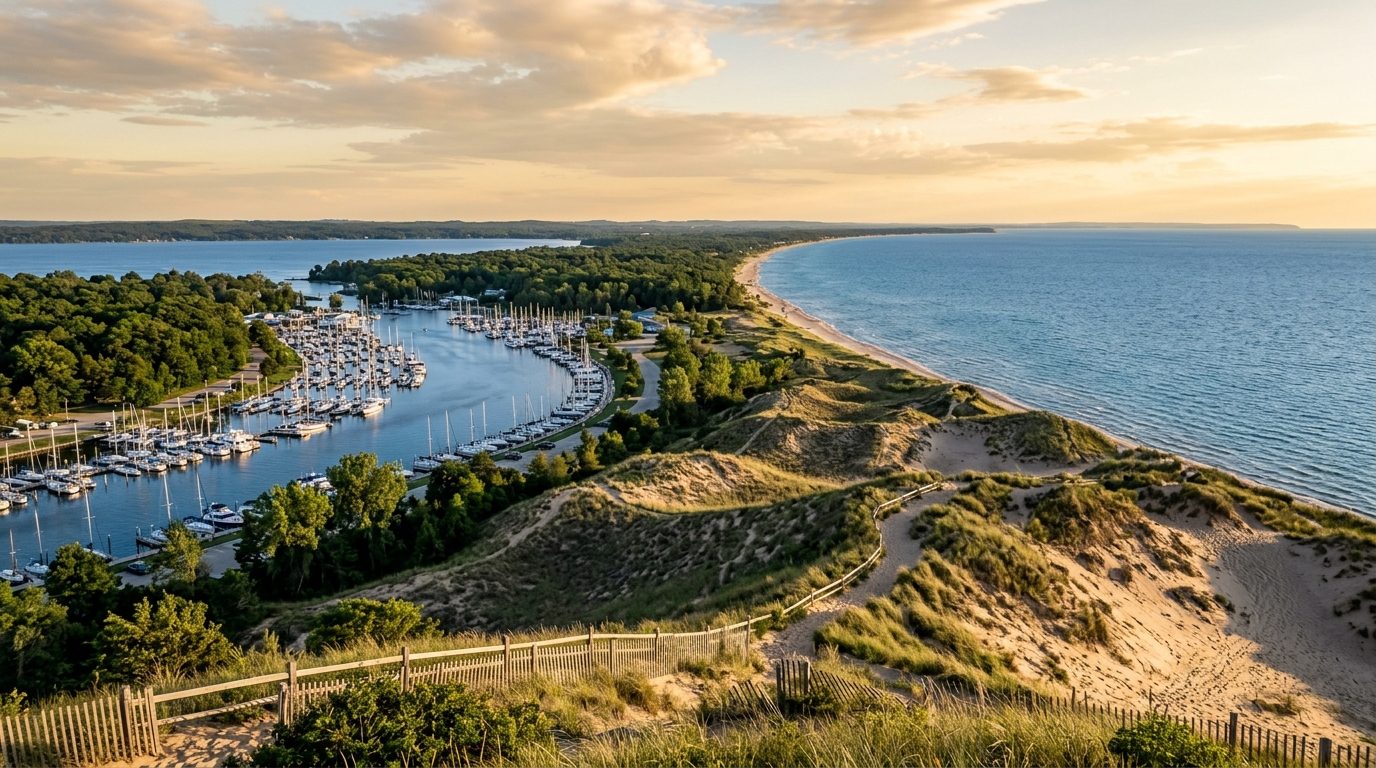
Current real estate market data, news and analysis for the Muskegon-Norton Shores, MI metropolitan area — 177,901 residents across Muskegon county.
Data as of May 2026. Sources: Redfin Data Center, U.S. Census Bureau.
Latest Muskegon Real Estate News
Coverage of this market is coming soon. Browse all housing market news.
Muskegon Real Estate Market Overview
Muskegon County sits directly on Lake Michigan’s eastern shore, anchored by Muskegon Lake, a drowned river-mouth harbor that has shaped the area’s development since the lumber era. Dune ridges line the Lake Michigan shoreline, White Lake forms a second, smaller waterfront community around Whitehall and Montague to the north, and the county’s inland reaches around Casnovia and Ravenna remain wooded and agricultural. Housing stock reflects that layered history: late-19th and early-20th-century Victorian homes and worker cottages fill Muskegon’s older core neighborhoods, mid-century ranch houses dominate Norton Shores and Roosevelt Park, and older seasonal cottages line White Lake near Whitehall and Montague. Newer construction is concentrated in waterfront redevelopment along downtown Muskegon Lake and in suburban subdivisions in Norton Shores and Fruitport.
Direct water access is the strongest driver of price tiers here. North Muskegon, a small lakefront community between Muskegon Lake and Lake Michigan with its own well-regarded schools, and lakefront pockets of Norton Shores near Lake Harbor and Mona Lake, sit toward the top of the local range, as does the White Lake shoreline around Whitehall and Montague, long a seasonal and vacation-home market. New waterfront condominium and marina development along downtown Muskegon Lake is adding a newer, higher-priced segment in a formerly industrial area. Muskegon Heights and older, formerly industrial neighborhoods within the city of Muskegon offer smaller and older housing stock at more affordable prices, while inland rural townships trade lake proximity for larger lots and lower land costs.
The local economy has shifted from heavy industry toward healthcare, advanced manufacturing and life sciences. Trinity Health’s Muskegon hospital is among the county’s largest employers, and aerospace manufacturing is a significant presence, with GE Aerospace producing turbine components in Muskegon and Howmet Aerospace operating a casting plant in Whitehall. Grand Valley State University maintains a regional center in Muskegon along with a water-resources institute and a renewable-energy center at the Muskegon Innovation Hub on the lakefront. The U.S. Coast Guard operates a small-boat station on Muskegon Lake, and Michigan’s Adventure, the state’s largest amusement and water park, is a significant seasonal employer in the county. The Lake Express ferry links Muskegon to Milwaukee across Lake Michigan. A former agrochemical plant north of the city is being redeveloped by a pharmaceutical-resin manufacturer, part of a broader shift away from the county’s legacy chemical and heavy-manufacturing base.
Michigan regulates construction, grading and vegetation removal in mapped critical dune areas along the Lake Michigan shoreline, and the state separately tracks high-risk erosion areas where documented bluff loss has occurred — both are worth checking before buying any lakefront lot. Michigan’s property tax rules uncap a home’s taxable value to current market value upon sale, so a buyer’s first tax bill is often higher than the seller’s, and the state’s homestead exemption applies only to a primary residence, not seasonal property, which matters for buyers eyeing a cottage on White Lake. Waterfront buyers on inland lakes should also confirm riparian and dock rights locally, and anyone considering property near a former industrial site should check state environmental records first.
Cities and Towns in the Muskegon Metro Area
Notable Communities and Neighborhoods
Muskegon Real Estate Market FAQ
How is the Muskegon-area market organized?
Muskegon County’s market centers on Muskegon Lake and the Lake Michigan shoreline, with the city of Muskegon and neighboring Norton Shores forming the urban core, North Muskegon and Fruitport as smaller nearby communities, and Whitehall and Montague forming a distinct waterfront market around White Lake to the north. Inland townships such as Casnovia and Ravenna remain more rural.
Which parts of the Muskegon area tend to be priciest?
Direct water access drives price tiers more than any other factor. Lakefront areas of North Muskegon, Norton Shores near Lake Harbor and Mona Lake, and the White Lake shoreline around Whitehall and Montague tend to command the most, along with newer waterfront redevelopment along downtown Muskegon Lake.
What should buyers verify locally in the Muskegon area?
Anyone considering a Lake Michigan or Muskegon Lake lot should check whether it falls within a state-regulated critical dune area or a mapped high-risk erosion area, since both affect what can be built or rebuilt. Buyers of a seasonal or vacation property should also confirm how Michigan’s homestead property-tax exemption does, and does not, apply to non-primary residences.
What’s a region-specific risk to know about in Muskegon?
Shoreline erosion along Lake Michigan is an ongoing, documented issue in parts of the county, with real bluff loss recorded during high-water years. Buyers of lakefront or near-shore property should independently verify a parcel’s erosion history and dune-area regulatory status rather than assume long-term stability.
Nearby Markets