
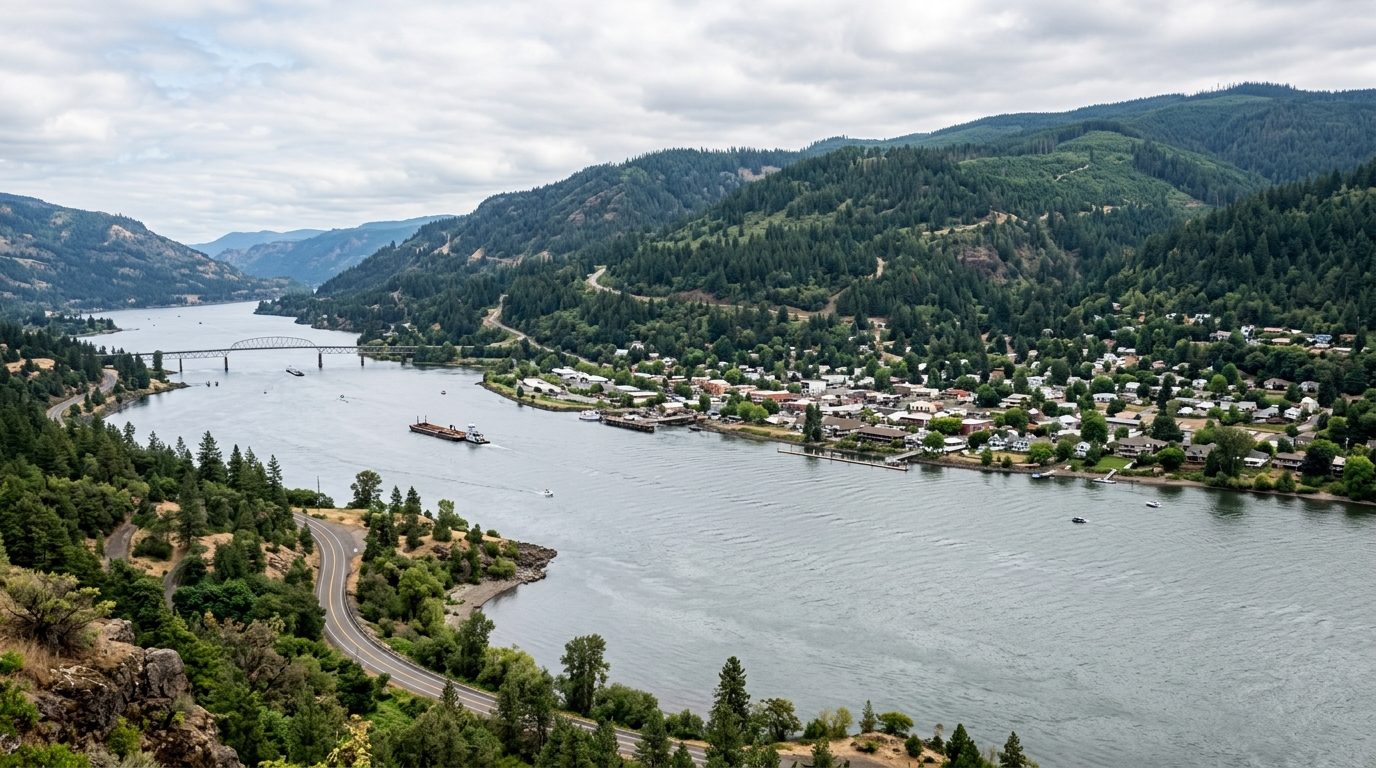
Current real estate market data, news and analysis for the Longview-Kelso, WA metropolitan area — 114,885 residents across Cowlitz county.
Data as of May 2026. Sources: Redfin Data Center, U.S. Census Bureau.
Latest Longview Real Estate News
Coverage of this market is coming soon. Browse all housing market news.
Longview Real Estate Market Overview
The Longview-Kelso metro sits in the lower Columbia River valley in southwest Washington, where the Cowlitz River flows north to south before joining the Columbia across from Oregon. Longview is a planned city, laid out from farmland and tideflats by the Long-Bell Lumber Company as an engineered company town with a radiating downtown civic core, wide boulevards, and residential districts platted for particular income levels. That origin shows in the housing stock: neighborhoods near the civic center and Lake Sacajawea hold Craftsman bungalows, Colonial Revivals, and modest cottages built for mill families, while hillside subdivisions to the north and west carry ranch-style and split-level homes from the postwar decades alongside newer construction. Kelso, older and less formally planned, grew along the river and rail lines with a tighter, more conventional grid. Terrain alternates between flat river-bottom land used historically for mills, rail yards, and agriculture, and steep forested hillsides ringing the valley that limit new subdivisions.
Homes set higher on the hillsides, in areas such as the Highlands and parts of Columbia Heights, tend to command more, largely because they sit above the floodplain, offer river or hillside views, and skew toward more recently built or renovated housing. Older, flatter neighborhoods closer to downtown Longview and industrial Kelso generally trade at lower price points, reflecting smaller lots, older systems, and proximity to rail lines and mill sites. Waterfront parcels along the Columbia and Cowlitz mix premium view lots with lower-lying ground subject to flood considerations, so price does not track distance to water in a simple way. Outlying towns such as Woodland and Kalama, closer to the Portland-Vancouver job market along Interstate 5, tend to draw commuter buyers and price somewhat differently than housing deeper in the metro’s core.
The regional economy still carries the imprint of its founding industry. Timber and paper manufacturing remain central, anchored by Weyerhaeuser’s lumber and wood-products operations and by WestRock’s Longview mill, successor to the historic Longview Fibre paper and packaging operation, converting timber into kraft paper, containerboard, and pulp. The Port of Longview handles bulk cargo, agricultural exports, and marine freight, anchoring a cluster of industrial and logistics employers. Healthcare has grown into a pillar of its own, led by PeaceHealth St. John Medical Center, the area’s major hospital and one of its largest employers outside heavy industry. Construction firms such as J.H. Kelly, a longtime mechanical contractor based in Longview, round out the base, alongside school districts and Lower Columbia College.
Living here means weighing a few distinctive local factors. The Cowlitz and Toutle rivers carry sediment deposited by the 1980 eruption of Mount St. Helens, which continues to raise riverbeds and elevate flood risk in low-lying parts of Longview and Kelso, a concern local floodplain managers actively monitor. Mount St. Helens remains an active volcano, and parts of the surrounding valleys fall within mapped lahar and ashfall hazard zones that inform local emergency planning, though the volcano itself sits well outside the developed area. Washington levies no personal income tax, shaping cost-of-living comparisons for arrivals from income-tax states, though property tax and local levies still apply. The industrial heritage also means parcels near old mill sites can warrant a look at environmental history, and the river-valley setting brings seasonal fog and a milder, wetter climate than areas farther from the Columbia.
Cities and Towns in the Longview Metro Area
Notable Communities and Neighborhoods
Longview Real Estate Market FAQ
What is the Longview-Kelso metro area known for?
It’s centered on Longview, a fully planned city built by the Long-Bell Lumber Company as a company town, and neighboring Kelso, its older river-and-rail counterpart. The area’s identity is rooted in timber and paper manufacturing along the lower Columbia River.
What towns make up the Longview-Kelso metro area?
The metro spans Cowlitz County and includes Longview, Kelso, Kalama, Woodland, and Castle Rock, along with unincorporated communities in between.
Is flooding a concern in the Longview-Kelso area?
Yes. Parts of Longview and Kelso sit in low-lying ground along the Cowlitz and Columbia rivers, and sediment carried downstream from Mount St. Helens has raised riverbeds over time, which local floodplain managers factor into risk planning for property along the rivers.
How close is Longview-Kelso to Portland and the Puget Sound area?
The metro sits along Interstate 5 in southwest Washington, within a manageable drive of the Portland-Vancouver area to the south and Olympia and the greater Puget Sound region to the north, making it accessible for commuters while retaining its own distinct, smaller-scale housing market.
Nearby Markets