
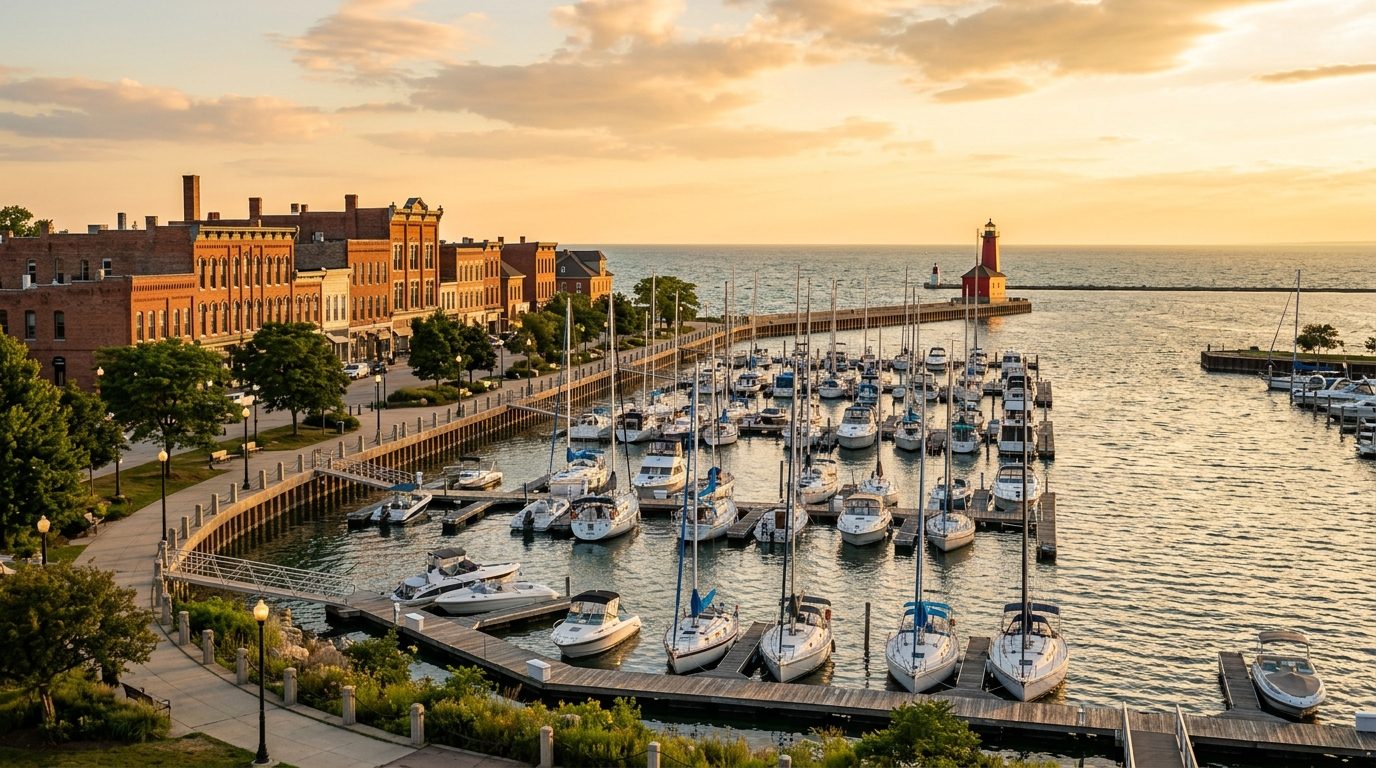
Current real estate market data, news and analysis for the Kenosha, WI metropolitan area — 168,448 residents across Kenosha county.
Sources: U.S. Census Bureau.
Latest Kenosha Real Estate News
Coverage of this market is coming soon. Browse all housing market news.
Kenosha Real Estate Market Overview
Kenosha County occupies the southeastern corner of Wisconsin, its eastern edge fronting Lake Michigan along a shoreline that runs from the Illinois state line north through the city of Kenosha and into Pleasant Prairie and Somers. The county sits roughly midway along the Chicago-Milwaukee corridor, close enough to both metropolitan cores that daily commuting in either direction is common, while still retaining a distinct small-city and small-town character. The city of Kenosha, the county seat, grew up as a lake port and manufacturing center, and its core neighborhoods still show that history in blocks of brick worker cottages, foursquares, and early-twentieth-century homes near the harbor. Farther from the lakefront, the housing stock shifts toward postwar ranches and split-levels, and, in the newer villages to the west, toward contemporary subdivisions built on former farmland.
Within the county, the areas closest to Lake Michigan and the redeveloped harbor in the city of Kenosha, along with lake-oriented sections of Pleasant Prairie, tend to sit toward the higher end of the local price range, largely because of water proximity, mature tree cover, and walkable access to the harborfront district. New-construction subdivisions built in recent years near the Interstate 94 corridor in Pleasant Prairie and Somers also command more, reflecting current building costs and proximity to the county’s newer employment centers. Farther inland and to the west, in the more rural and lake-recreational towns and villages, homes tend to be more modestly priced, reflecting older or smaller housing stock, greater distance from job centers and the Metra line, and, in unincorporated areas, reliance on private wells and septic systems rather than municipal utilities.
Kenosha County’s economy has shifted heavily toward logistics, distribution, and manufacturing, driven by its position along Interstate 94 between Chicago and Milwaukee. Uline, the packaging and shipping supply distributor, is headquartered on a large corporate campus in Pleasant Prairie, and Amazon operates a large fulfillment center in the city of Kenosha. HARIBO built its first North American manufacturing plant in Pleasant Prairie’s Prairie Highlands Corporate Park to produce its gummi candies. Longstanding manufacturers remain rooted in the city of Kenosha itself: Snap-on, the tool maker, and Jockey International, the apparel company, both keep their world headquarters there. Health care is anchored by Froedtert South, which operates hospital and clinic facilities in Kenosha and Pleasant Prairie, alongside an Advocate Health medical center also in Pleasant Prairie. Higher education is represented by the University of Wisconsin-Parkside and Carthage College, both employers as well as community institutions.
A few local factors distinguish this market. The Kenosha station is the only Metra commuter rail stop outside Illinois, giving residents direct rail access into downtown Chicago and shaping demand near the depot and downtown. Property and income tax structures differ from neighboring Lake County, Illinois, which has drawn some buyers north across the state line. Along the immediate lakeshore, bluff erosion and periodic high Lake Michigan water levels are recognized hazards, so shoreline buyers should check bluff stability, flood zone status, and insurance requirements before purchasing. Several of the county’s municipalities have recently reorganized, merged, or incorporated, and zoning, services, and utility availability can vary from block to block, so buyers should confirm which municipality, school district, and utility or septic system actually serves a given property.
Cities and Towns in the Kenosha Metro Area
Notable Communities and Neighborhoods
Kenosha Real Estate Market FAQ
How is the Kenosha County real estate market organized geographically?
The market splits broadly into three bands: the Lake Michigan shoreline and harbor area within the city of Kenosha and eastern Pleasant Prairie; the Interstate 94 corridor running through Pleasant Prairie and Somers, where newer subdivisions have grown up near logistics and manufacturing employment; and the more rural, lake-dotted towns and villages to the west, including Bristol, Salem Lakes, Twin Lakes, and Paddock Lake, which are more agricultural in character and oriented around smaller inland lakes rather than Lake Michigan.
Which parts of Kenosha County tend to be priced higher, and why?
Homes directly on or near the Lake Michigan shoreline and the redeveloped harbor in the city of Kenosha, along with lakefront sections of Pleasant Prairie, generally command a premium because of water proximity and walkability to the harborfront. Newer subdivisions near the Interstate 94 corridor also tend to price higher, reflecting current construction costs and proximity to the county’s employment base, while older inland housing stock and more rural western towns tend to be priced more modestly.
What should a buyer verify before purchasing property in Kenosha County?
Because the county includes a mix of cities, villages, and towns with different service levels, buyers should confirm which municipality and school district a property falls in, whether it is served by municipal water and sewer or by a private well and septic system, and how any local zoning or subdivision rules might affect future use of the land, particularly in the county’s more rural western towns.
What lakeshore-specific risk should buyers along Lake Michigan be aware of?
Properties along or near the Lake Michigan bluff can be affected by shoreline erosion and by fluctuating lake water levels, which periodically bring increased flooding and bluff instability. Buyers considering shoreline or near-shoreline property should have bluff and foundation conditions evaluated and check flood zone designation and insurance requirements before closing.
Nearby Markets