
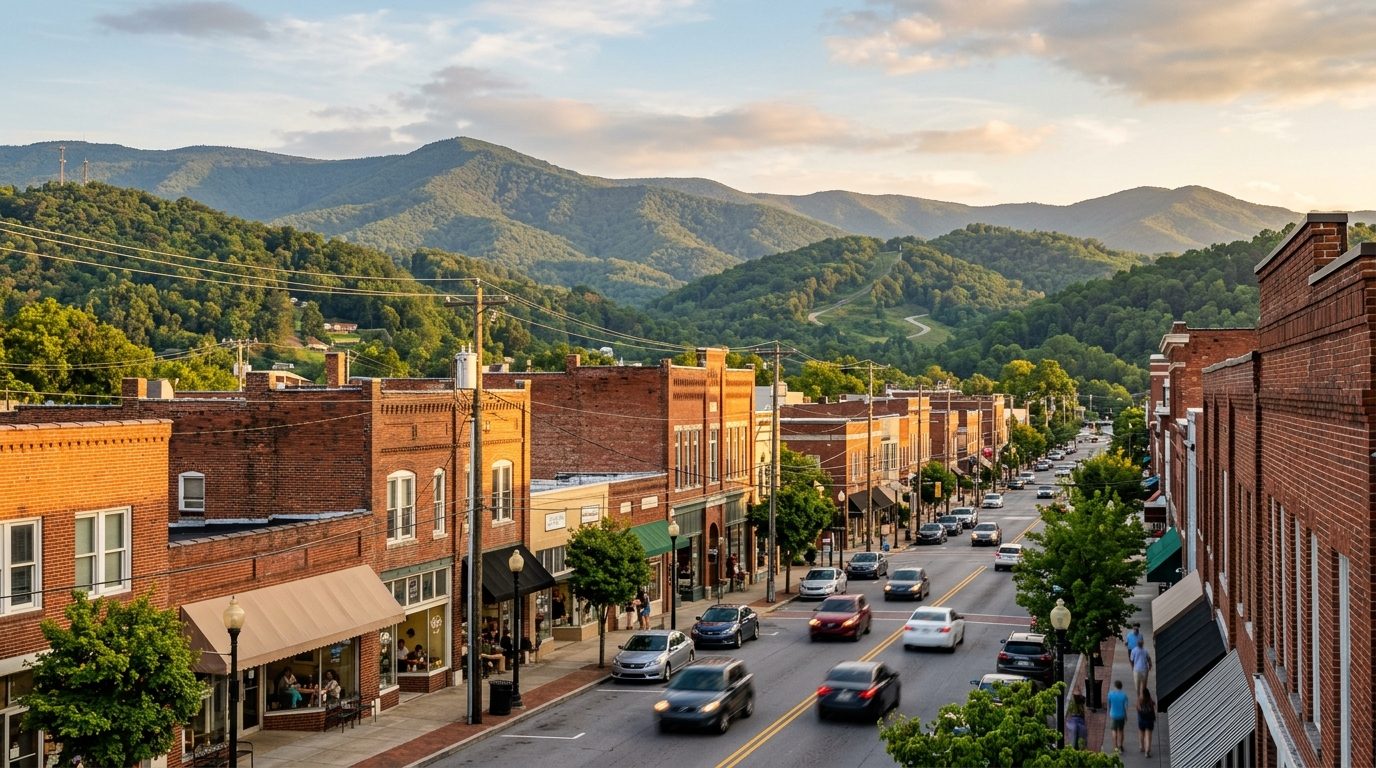
Current real estate market data, news and analysis for the Johnson City, TN metropolitan area — 216,416 residents across Carter, Unicoi and Washington counties.
Data as of May 2026. Sources: Redfin Data Center, U.S. Census Bureau.
Latest Johnson City Real Estate News
Coverage of this market is coming soon. Browse all housing market news.
Johnson City Real Estate Market Overview
Johnson City anchors the Tri-Cities region of northeast Tennessee, where the Appalachian Ridge-and-Valley landscape gives way to Blue Ridge Mountain foothills. Buffalo Mountain rises along the city’s southern edge, Roan Mountain is visible to the southeast, and the Watauga arm of Boone Lake and the Nolichucky River touch parts of the metro. The area spans Washington, Carter, and Unicoi counties, taking in Johnson City along with Elizabethton, Erwin, Jonesborough, Unicoi, and Watauga, and terrain shifts from a developed valley floor near Johnson City to steeper river valleys toward the North Carolina and Virginia lines. Housing stock reflects that range: brick ranch homes and mid-century subdivisions, newer traditional and golf-course subdivisions on the city’s edges, historic Victorian and Federal-style homes downtown and in Jonesborough, and farmhouses, cabins, and larger-acreage new construction climbing into the outlying counties.
Higher-priced housing clusters around golf and country-club developments on Johnson City’s western side, where newer construction, larger lots, and well-regarded schools drive demand. Established, tree-lined neighborhoods near downtown and East Tennessee State University also command a premium for mature landscaping and closeness to the medical corridor. Lakefront property along Boone Lake and Watauga Lake carries a premium tied to water access and mountain views, as do homes with a clear vantage of Buffalo Mountain or the Blue Ridge skyline. Lower-priced housing is more common in older mill-town sections of Elizabethton and Erwin, older housing scattered through Johnson City, and remote parts of Carter and Unicoi counties, where distance from jobs offsets the appeal of privacy and acreage.
The economy centers on healthcare, higher education, and manufacturing. Ballad Health, headquartered in Johnson City, operates Johnson City Medical Center and Franklin Woods Community Hospital and ranks among the area’s largest employers. East Tennessee State University, including its Quillen College of Medicine, anchors the job base and the med-tech corridor around the health sciences campus, while the Quillen VA Medical Center at Mountain Home adds federal jobs, and Milligan University near Elizabethton is another education employer. A.O. Smith runs a water-heater plant in Johnson City, and BWXT’s Nuclear Fuel Services facility in Erwin, which manufactures naval nuclear fuel material, is Unicoi County’s largest private employer and is expanding. City, county, and state government round out the base, and Eastman Chemical in nearby Kingsport draws commuters from across the metro.
Flood risk is a real, documented concern here: Hurricane Helene’s remnants in September 2024 sent the Nolichucky and Watauga rivers to historic levels, destroyed the hospital in Erwin, collapsed interstate bridges, and caused severe damage in low-lying parts of Unicoi and Carter counties. Buyers should check flood maps and local flood history near these rivers or the Watauga Lake shoreline. Tennessee has no state income tax, and property tax rates vary by county and city limits, so buyers should confirm rates for the specific town or unincorporated area. Public transit is limited to a small local bus system, so most residents rely on personal vehicles, and commutes lengthen once a property sits up a mountain hollow or across a river. Steep-slope building, septic systems, and well water are common outside the towns; buyers should verify septic and well condition, private-drive maintenance, and deed restrictions in planned communities. Development concentrates along Interstate 26 and Boone’s Creek, while downtown Johnson City and Jonesborough have seen infill activity.
Cities and Towns in the Johnson City Metro Area
Notable Communities and Neighborhoods
Johnson City Real Estate Market FAQ
How is the Johnson City metro area organized geographically?
The metro covers Washington, Carter, and Unicoi counties in the Appalachian foothills of northeast Tennessee, part of the Tri-Cities region alongside Kingsport and Bristol. Johnson City is the urban center, with Elizabethton, Erwin, Jonesborough, Unicoi, and Watauga forming smaller towns around it. The landscape moves from a relatively flat, developed valley floor near Johnson City to increasingly steep river valleys and mountain terrain toward the North Carolina and Virginia state lines.
Which areas of Johnson City tend to be pricier, and why?
Golf and country-club developments on the west side of the city, along with established tree-lined neighborhoods near downtown and East Tennessee State University, tend to command higher prices due to newer construction, mature landscaping, and proximity to schools and the medical corridor. Lakefront property along Boone Lake and Watauga Lake, and homes with mountain views of Buffalo Mountain or the Blue Ridge, are similarly sought after. Older mill-town sections of Elizabethton and Erwin and more remote parts of Carter and Unicoi counties tend to be less expensive because of distance from jobs and services.
What should buyers verify locally before purchasing a home in this metro?
Buyers should confirm which taxing jurisdiction a property falls under, since city and county property tax rates differ across Johnson City, Elizabethton, Erwin, Jonesborough, and unincorporated county land. Outside the towns, it is important to verify septic system and well water condition, road maintenance responsibility on private or shared drives, and any deed restrictions tied to golf-course or planned communities. Given the region’s terrain, checking flood zone status and floodplain history for any property near a river or lake is also essential.
What flood or terrain-related risks are specific to this region?
This metro sits in river valleys below steep mountain terrain, which makes flash flooding a genuine risk along the Nolichucky, Watauga, and Doe rivers and around Watauga Lake; Hurricane Helene’s remnants in September 2024 caused catastrophic flooding, destroyed a hospital in Erwin, and collapsed interstate bridges in the area. Construction on steep slopes elsewhere in Carter and Unicoi counties also raises considerations around drainage, erosion, and access road stability that are worth investigating property by property.
Nearby Markets