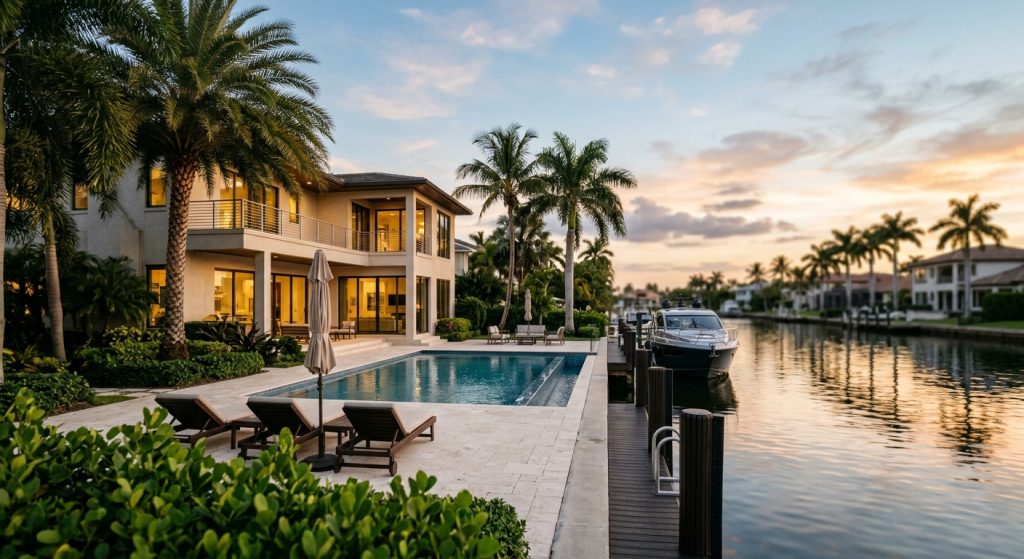
The price of entry to the U.S. luxury housing market fell for a 31st straight month in October, but a dozen metros, most of them in the South and five in Florida, are moving the other way. The national luxury threshold, the listing price of the top 10% of homes, was $1,197,014 in October, down 2.3% from a year earlier, according to Realtor.com’s October 2026 Luxury Housing Report, published Nov. 9.
The decline steepens toward the top of the market. The 95th-percentile threshold fell 4.1% to $1,873,040 and the 99th percentile, which Realtor.com calls ultraluxury, fell 6.2% to $5,125,874. All three tiers have now declined year over year for 31 consecutive months, and the ultraluxury threshold fell about 2.7 times as fast as entry luxury, the report said. From September, the 90th percentile slipped 0.2%, the 95th slipped 0.7% and the 99th was essentially unchanged.
Luxury homes are selling faster
Even as thresholds slid, luxury homes sold faster. The median luxury listing spent 73 days on the market in October, five days faster than a year earlier, while the median listing overall took 63 days, essentially flat. The 95th-percentile tier sat for 81 days, four days faster, and the 99th for 97 days, six days faster. Million-dollar listings slipped to 12.3% of all listings, down 0.5 percentage points.
The national picture is little changed from the summer, when Realtor.com’s August report showed the entry point to luxury near $1.2 million after a 29th straight annual decline.
Where luxury prices are rising
Of the 43 metros in the report’s dataset, those averaging at least 500 million-dollar listings over the past year, 12 posted year-over-year gains of 1% or more in their entry-luxury threshold. Naples-Marco Island, Fla., led with a 9.0% gain to $3,753,333, followed by North Port-Bradenton-Sarasota, Fla. (up 7.7% to $1,796,850), Charleston-North Charleston, S.C. (up 4.7% to $2,087,280), Raleigh-Cary, N.C. (up 4.3% to $1,095,500) and Boise City, Idaho (up 4.2% to $1,395,600). The other seven ranged from a 1.0% gain in Detroit to 4.1% in both Cape Coral-Fort Myers, Fla., and Miami-Fort Lauderdale-West Palm Beach.
The South accounts for eight of the 12, and Florida alone holds five: Naples, North Port, Cape Coral, Miami and Tampa-St. Petersburg-Clearwater. The list also leans toward vacation and destination markets, the report notes, including Charleston, Las Vegas, Nashville, Tenn., and the resort market of Atlantic City-Hammonton, N.J. Naples is the only one of the 12 that also ranks among the 10 most expensive luxury markets, so the strongest gains are mostly coming from outside the priciest tier.
The gains extend higher up the ladder in those markets. Eight of the 12 saw their 90th, 95th and 99th percentile thresholds all rise from a year ago, the opposite of the national trend. The biggest 99th-percentile gains came in Charleston, up 18.7% to $8,044,460; Boise, up 16.6% to $3,499,000; and Atlantic City, up 15.9% to $8,998,499. Five of the growth metros, Detroit, Tampa, Raleigh-Cary, Cape Coral and Las Vegas, have entry-luxury thresholds below the national level, from $719,087 in Detroit to $1,196,475 in Las Vegas.
Florida and the rest of the list diverge on pace and supply. Four of the five Florida metros sold luxury listings faster than a year ago, led by Naples at 100 days (down 21.1%) and Cape Coral at 94 days (down 16.1%), while million-dollar listing counts fell in all five, from 2.1% in Tampa to 11.5% in Naples. Outside Florida, luxury listings took longer to sell in six of the seven growth metros, including Charleston (79 days, up 11.3%) and Detroit (56 days, up 15.6%), and million-dollar inventory rose in all seven, led by Nashville (up 15.2%), Raleigh-Cary (up 12.6%) and Las Vegas (up 11.6%). Nationally, the count of million-dollar listings rose 3.0%.
On our reading, that split matters: in Florida, rising luxury thresholds are coming with shrinking supply and faster sales, while elsewhere prices are rising even as more expensive homes come to market and take longer to sell.
The priciest markets are slipping
The most expensive markets are mostly losing value. The same 10 metros topped the price ranking as in September, but Naples was the only one with an annual gain; the steepest declines were in San Jose (down 12.1%), New York-Newark-Jersey City (down 11.3%) and San Francisco-Oakland-Fremont (down 7.1%). The sharpest drop in the full 43-metro dataset was in Boston, at 13.3%.
Bridgeport-Stamford-Danbury, Conn., took the top spot in October, with its top 10% of listings starting at $3,960,000, 3.3 times the national threshold. It climbed from fourth place in September on a 10.1% monthly gain, after a 7.3% decline the month before, but remains down 6.8% from a year earlier. The report cautions that Bridgeport averaged only 536 million-dollar listings over the past year, compared with 11,453 in New York and 9,194 in Los Angeles, making its prices more prone to swings. Los Angeles-Long Beach-Anaheim ranked second at nearly $3.9 million, followed by Naples at roughly $3.8 million, Kahului-Wailuku, Hawaii, at about $3.7 million and San Jose at nearly $3.3 million.
“Although the price point for entry luxury has had 31 consecutive months of annual decline at the national level, there are markets where prices are climbing, and in some cases well above the year ago levels,” wrote Anthony Smith, the Realtor.com senior economist who authored the report. The figures are based on listing prices for existing homes on MLS feeds, not final sale prices. More high-end market coverage is in our luxury real estate section.