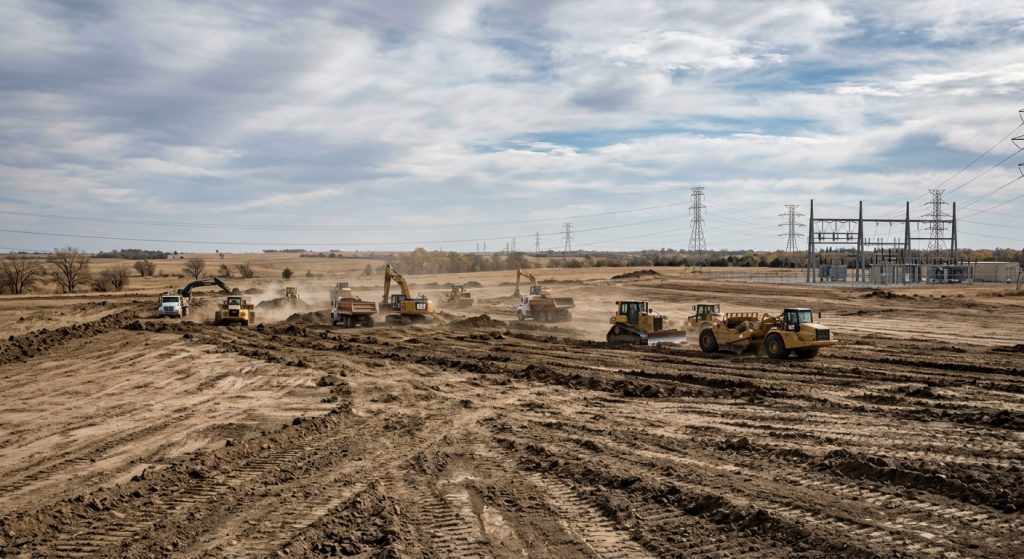
Google has confirmed it is the end user behind a 506-acre data center campus under construction in unincorporated Tulsa County, Okla., ending months of speculation about the project developed under the code name “Project Clydesdale.”
Google and developer Beale Infrastructure released details of the campus, located near Cherokee Industrial Park just west of Owasso, according to KTUL. Beale broke ground on the site in October 2025.
The disclosure adds to a substantial Oklahoma footprint. Google has invested more than $15 billion in the state since opening its first data center campus in Pryor in 2011, and the company says its Oklahoma operations generated $2.6 billion in economic activity in 2025. Additional Google facilities are under construction in Stillwater and Muskogee County.
Power and water commitments
The utility infrastructure accompanying the project reflects how data center developers have responded to community pushback over resource consumption. Beale is funding a new on-site substation, powered by Public Service Company of Oklahoma. The project will also fund and install 1.5 miles of new water lines and infrastructure upgrades for the Washington County Rural Water District — improvements Google says will strengthen the water system for neighboring users, not only the campus.
Google has signed commitments for 2.5 gigawatts of new power generation and storage projects in Oklahoma since 2011. On workforce, the company is supporting a program with the electrical training ALLIANCE to train existing electrical workers and add more than 160 apprentices in the state by 2030. Google says it has contributed more than $2 million to local partners in recent years.
“Building data centers the right way means being a good neighbor first,” said Trystine Payfer, Google’s public affairs manager for Oklahoma.
Local officials welcomed the confirmation. “This shows that Tulsa County can compete and win on a global stage,” said Tulsa County Commissioner Stan Sallee. Mike Neal, president and CEO of the Tulsa Regional Chamber, said “Google is synonymous with quality and commitment to community,” while Owasso Chamber President and CEO Chelsea L. Feary said the project “strengthens our position as a region that can compete for major investment.”
What it means
The pattern here is worth noting for anyone tracking data center development: a project entitled and started under a code name, with the hyperscaler’s identity confirmed only after construction is underway. That sequencing is common — it limits land-price escalation and political organizing during the assembly phase — but it has become a source of local friction in jurisdictions where residents learn the end user late.
Google’s emphasis on water lines, substation funding and apprenticeships reads as a direct response to that dynamic. Utility cost-shifting and water consumption are the two issues driving moratoriums elsewhere, and funding infrastructure that also serves existing residents is the industry’s emerging answer. Whether it holds in Oklahoma as the state’s data center concentration grows is an open question; the commitments are documented, their sufficiency is a political judgment.
For industrial land owners in the Tulsa corridor, the confirmation validates the region’s positioning on power availability — the input that now governs siting more than labor or land cost.
Google has been expanding aggressively across the Southeast and Midwest, including a project where it was named the end user of an 8 million-square-foot campus in Columbia, Georgia, and a possible expansion at its LaGrange, Georgia, campus signaled by a state filing. The buildout is straining power supply nationally, prompting projects like Brookfield and NextEra’s $100 billion campus on a former Kentucky uranium site.