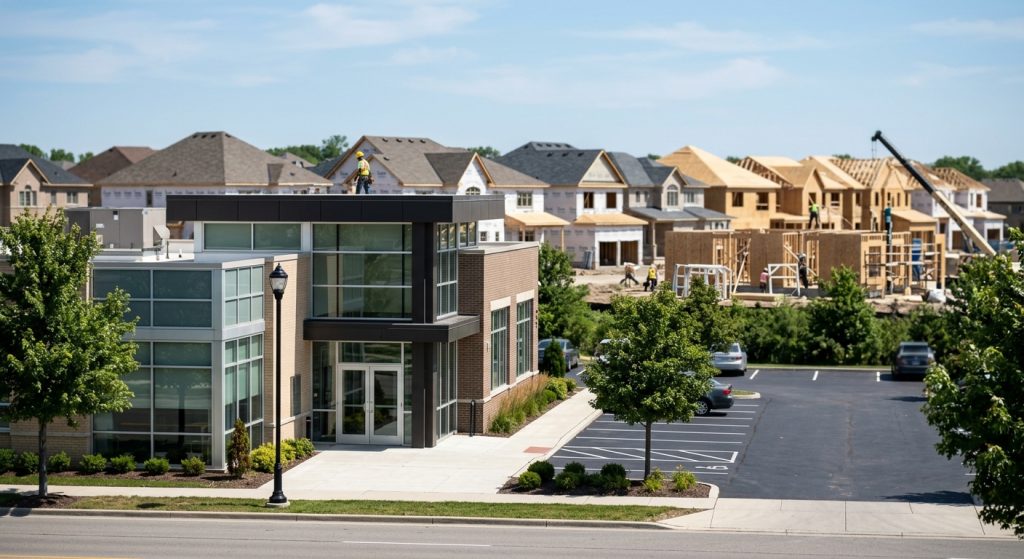
The nation’s largest banks are committing tens of billions of dollars to fixing the housing supply shortage, with JPMorgan Chase alone pledging $750 billion in housing-market initiatives through 2035, according to reporting by Realtor.com published Aug. 24, 2026. Wells Fargo, Citibank and Bank of America — which along with JPMorgan make up the “big four” of American banking — have each rolled out major housing programs of their own.
JPMorgan’s “American Dream Initiative” aims to build or preserve 1 million affordable housing units and help 500,000 customers buy homes, 200,000 of them first-time buyers. Sam Sheets, a strategy executive for Community & Affordable Lending at JPMorgan Chase, said the nationwide supply shortage leaves banks little choice but to get involved. “At the end of the day, it’s a function of supply and demand,” Sheets said. “Supply is the big issue — and supply of homes at the right price point.”
A $750 Billion Bet, and Three More Behind It
Citi launched its own “Blueprint for Housing Opportunity Initiative” this year, a $60 billion plan to support the preservation and construction of 250,000 homes — roughly double the pace of the $7 billion it financed last year to support 30,000 units. Citi is also directing $50 million to housing nonprofits, including seed funding for pre-development work such as architecture and zoning studies that help projects “turn dirt,” said Edward Skyler, head of Enterprise Services for Citi. “This is an issue that is really harming Americans across the country, and not just in the big cities,” Skyler said.
Wells Fargo has awarded $53 million through its “Housing Affordability Breakthrough Challenge” to back innovations in home construction and financing, and its foundation has contributed $830 million toward housing efforts since 2019. Bank of America has provided $15 billion in loans and grants since 2019 to support down payments, closing costs and affordable mortgage options, partnering with 300 housing counseling groups in the process.
Banks Are Also Pushing Policy Changes
Beyond direct lending and grants, the banks are lobbying for regulatory changes they say would lower the cost of building. JPMorgan has backed housing-market research through a policy center advocating for fewer regulatory barriers and more manufactured-housing innovation. “We’re really trying to look at what levers, and particularly state and local levers, that can reduce the cost drivers of what it takes to build housing,” Olivia Barrow Strauss, JPMorgan’s vice president of Housing Policy, told Realtor.com.
Citi’s blueprint pushes lawmakers to make the Low-Income Housing Tax Credit transferable, which Skyler said would draw more banks and investors into financing affordable projects. “We’re seeing a lot of money left on the table,” he said. “Our idea is simply to try and create a market for them.” At a Bipartisan Policy Center conference in Washington in June, Skyler said the private sector needs to help drive down construction costs: “We need American ingenuity and entrepreneurship to help us build cheaper. We need to apply some of this great intellectual capacity and allocate some of that brain power to housing, because it is ripe for innovation.”
The Business Case Behind the Philanthropy
The initiatives aren’t purely altruistic. Mortgage originations at large banks have hovered below 500,000 for the past three years, well below the million-plus levels typical before the pandemic, according to tracking from the Philadelphia Fed. Bernard Nossuli, chief operating officer at lending-data company iEmergent, said the mortgage business has been battered by high interest rates and uncertainty over when the Federal Reserve might change course. Roughly 581,000 home-purchase loans were originated from January through March 2026, down 19% from the prior quarter and a 12-year low.
Younger buyers are increasingly priced out while older owners stay “locked in” to low-rate mortgages, making supply-side fixes the most obvious lever left to pull, Nossuli said — though he cautioned “the reality is a lot more complicated than that.” Dennis Shea, co-leader of the Bipartisan Policy Center’s Terwilliger Center for Housing Policy, said the housing shortage carries broader economic costs, limiting labor mobility and productivity in ways that ultimately shrink banks’ own customer base.
At JPMorgan, Sheets said the bank is aggressively growing its mortgage business — it originated $52.8 billion in mortgage volume in 2025, up from $40.8 billion in 2024, according to its most recent financial reporting — and views its housing initiatives as part of a more comprehensive strategy to influence supply.
What It Means
The scale of the commitments — $750 billion from JPMorgan alone, plus tens of billions more from its three largest rivals — reflects both a genuine affordability crisis and a business calculation: banks that help unlock housing supply stand to originate more of the mortgages that come with it. RealtyWire has previously reported on JPMorgan’s role chairing the U.S. Chamber’s new Housing Advisory Council, part of the same push, and on NAHB data showing housing affordability worsened again in the second quarter as elevated rates continued to weigh on buyers. Whether bank capital and lobbying can meaningfully move zoning and building-code barriers — largely controlled at the state and local level — remains an open question the banks themselves acknowledge is more complicated than writing a check.