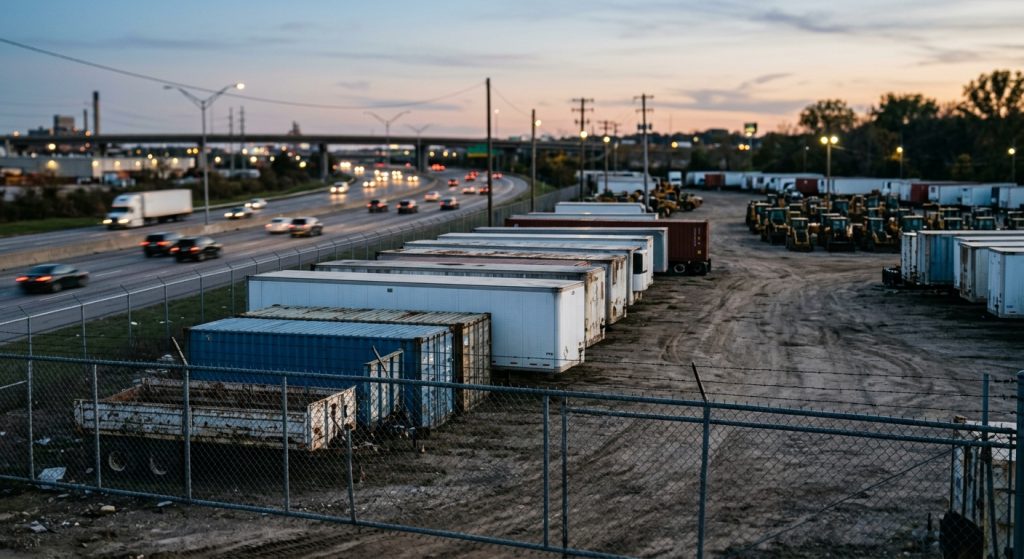
Starwood Property Trust and Realterm have co-originated a $672 million loan against a 78-property industrial outdoor storage portfolio, a deal the two firms say is the largest financing ever completed in the niche asset class, Bloomberg News reported Aug. 18.
Industrial outdoor storage, known in commercial real estate circles by the shorthand IOS, refers to fenced, often unpaved outdoor sites used to park truck trailers, shipping containers, construction equipment and commercial vehicles. The properties typically sit near ports, highways and distribution hubs, functioning as staging grounds for last-mile logistics rather than traditional warehouse space.
The debt refinances an existing $486 million mortgage on the portfolio, which spans 830 acres across 33 U.S. markets nationally. The properties are owned by affiliates of Stonemont Financial Group and Cerberus Capital Management, two investors that have built sizable outdoor-storage holdings in recent years as institutional interest in the sector has accelerated.
Starwood Property Trust, the Barry Sternlicht-led commercial mortgage REIT, and Realterm, a transportation- and logistics-focused investment manager that has expanded into direct lending, structured the loan jointly rather than through a single balance sheet — a co-origination approach increasingly used by large lenders to underwrite bigger, more complex deals while sharing risk.
“Borrowers are continuing to seek lenders with a deep understanding of the industrial real estate and logistics sectors,” Paul Sisson, Realterm’s head of credit, said in a statement.
The size of the loan stands out in a niche where financings have historically been measured in the low hundreds of millions of dollars. Earlier large IOS financings and portfolio deals — including a roughly $360 million portfolio assembled by Criterion Group and Columbia Pacific Advisors, a $281 million financing secured by Catalyst Investment Partners earlier this year, and a $231 million JLL-arranged loan on a 43-property, 293-acre portfolio — had each represented high-water marks for the sector at the time. At $672 million, the Realterm-Starwood loan is nearly double the previous largest deals tracked in the space, illustrating how quickly the ceiling for single IOS transactions has risen as more capital chases a limited supply of sites.
Realterm has built its lending platform partly to fill a gap left by traditional banks, which have pulled back from commercial real estate exposure broadly and from outdoor storage specifically, given the asset class’s relative newness and the specialized underwriting it requires — zoning complexity, environmental review and tenant credit among the variables that differ from conventional industrial leasing. Realterm itself is better known as an owner-operator, managing a large portfolio of IOS, transportation and logistics facilities across the U.S. and Europe; its credit arm has increasingly stepped in as a direct lender to other owners in the space, leveraging that operating expertise to underwrite deals banks are less equipped to evaluate.
Growing institutional footprint
Outdoor storage has moved from a niche play favored by specialist operators to a target for larger institutional capital as e-commerce growth compresses delivery timelines and pushes logistics operators to secure staging capacity closer to population centers. Blackstone and other large investors have entered the sector in recent years, drawn by supply constraints — many municipalities restrict or zone against new outdoor-storage development — and by tenants’ willingness to sign long-term leases for well-located sites.
That scarcity has also made refinancing existing portfolios, rather than new construction, a primary avenue for institutional capital to gain exposure, since assembling large IOS footprints from scratch is difficult amid limited new supply.
The borrowers, Stonemont Financial Group and Cerberus Capital Management, are among the more active consolidators in the space. Atlanta-based Stonemont has spent years acquiring and developing outdoor storage and industrial sites nationally, while Cerberus, the New York-based alternative investment firm, has built out a real estate platform targeting industrial and logistics-adjacent property alongside its traditional credit and private equity businesses. Combining their holdings into one 830-acre, 33-market portfolio gave the pair the scale to attract a financing package of this size.
What it means
The $672 million transaction is a marker of how quickly industrial outdoor storage has moved toward the center of institutional real estate credit. A deal of this size, co-originated by a public mortgage REIT and a sector-focused lender, suggests capital providers now view diversified, multi-market IOS portfolios as stable enough collateral to support financing at a scale once reserved for traditional industrial and logistics real estate. It also signals that Realterm’s credit platform is positioning itself as a go-to lender for large owners in the space, competing for business that banks have largely vacated. For owners like Stonemont Financial Group and Cerberus Capital Management, the refinancing — which increased proceeds by roughly $186 million over the prior loan — points to rising valuations across their outdoor-storage holdings and gives them fresh capital to continue expanding in a supply-constrained sector.
Starwood Property Trust’s involvement also comes as the REIT works through a broader push into diversified commercial real estate lending; the company reported a steep drop in second-quarter net income tied to losses in its corporate segment, even as its core lending business continues to originate large transactions like this one. The deal adds to a run of sizable industrial portfolio transactions this year, including TPG AG Real Estate and Redfearn Capital’s $628 million purchase of a Southeast industrial portfolio and Rexford Industrial’s planned $1.2 billion sale of Southern California industrial assets to EQT Real Estate, underscoring continued capital flows into industrial-adjacent real estate even as some traditional office and retail segments remain under pressure.