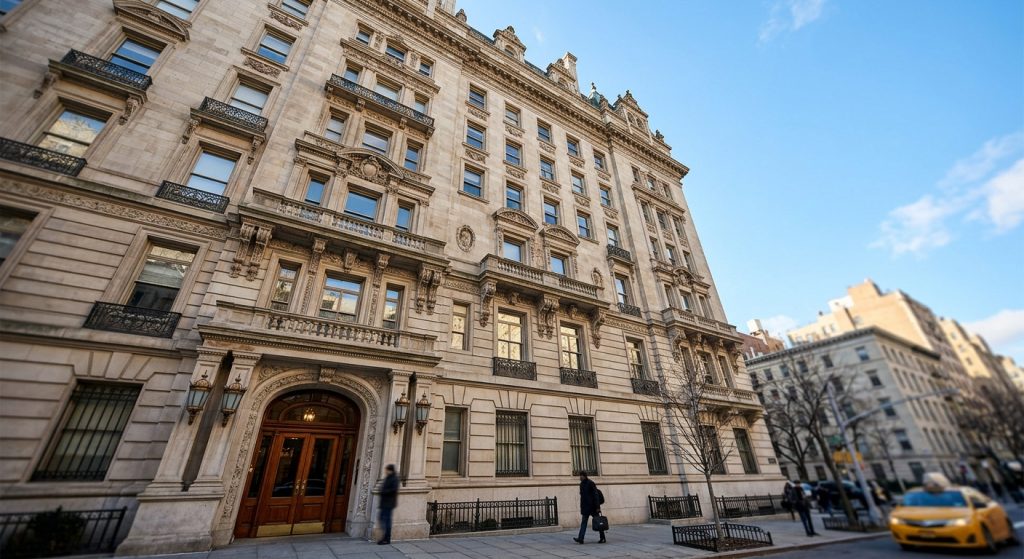
A Staten Island judge on Aug. 10 temporarily blocked New York City from enforcing its new “pied-à-terre tax” on non-primary luxury homes, ruling that the city’s rollout swept up hundreds of thousands of owner-occupied properties that were never supposed to be subject to the surcharge. The pause proved short-lived: City Hall’s immediate notice of appeal automatically stayed the order, leaving the tax’s enforcement machinery — including a public property list and notices already mailed to thousands of homeowners — largely in place until both sides return to court on Aug. 31.
The dispute is playing out as brokers report a parallel shift in Manhattan’s luxury market, where owners of high-value second homes have been listing units for rent rather than sale to sidestep the tax altogether.
What the Order Did — and Undid
Justice Wayne M. Ozzi of the New York State Supreme Court in Richmond County issued the temporary restraining order in a lawsuit brought by a group of city homeowners, including plaintiff Simon Hedley, represented by attorney Randy Mastro, a former first deputy mayor of New York City, according to amNewYork and Fox News. The suit does not challenge the legality of the tax itself. Instead, it argues the city’s Department of Finance botched the notification process — flagging primary residences as potentially taxable, publishing a database of more than 900,000 properties, and shifting the burden onto homeowners to prove they qualified for an exemption.
Ozzi’s order directed the city to take down the published property list and halt further action tied to roughly 17,000 notices already mailed to homeowners. Fox News reported the judge found the city “had not done its due diligence” and that the notices “caused irreparable harm.” AmNewYork reported Ozzi wrote that “no law permitted or required the City to publish such a list of the names, addresses, and property values of more than 900,000 New York City homeowners.”
Mastro called the rollout “a total debacle” and said the order “has vindicated the rights of hundreds of thousands of New York City homeowners,” according to CBS New York and Spectrum News’ NY State of Politics.
But the relief was brief. Under New York civil procedure, a government agency’s notice of appeal automatically stays a lower-court order, and the Mamdani administration’s Law Department filed one within hours. Mayoral spokesperson Matt Rauschenbach said in a statement carried by multiple outlets: “We disagree with today’s ruling, but we are confident in both the pied-à-terre surcharge and the City’s ability to implement it fairly and effectively.” City officials have said they intend to keep implementing the tax while the appeal and the Aug. 31 hearing proceed.
The Tax at the Center of the Fight
The pied-à-terre tax is an annual surcharge on residential properties in New York City that are not a primary residence, targeting one-to-three-family homes valued at $5 million or more and condominium or cooperative units valued at $1 million or more. Gov. Kathy Hochul signed it into law this spring as part of the state budget, and it took effect July 1. City officials have projected it could generate roughly $500 million a year to help close a budget shortfall, though the New York City Comptroller’s office has separately estimated that behavioral responses — including owners converting units to rentals, which are exempt when leased to a tenant using the unit as a primary residence — could push actual collections meaningfully below that target, according to a Comptroller’s office analysis.
That rental exemption is central to why the tax has been reshaping owner behavior since before this week’s ruling. Manhattan’s luxury sales market held up through the second quarter even as the tax loomed, with the median sale price hitting a record $1.25 million and luxury listing inventory falling to its lowest level in 22 years of tracking by Douglas Elliman and Miller Samuel, according to CNBC. At the same time, brokers told CNBC that owners weighing a sale were increasingly opting to rent instead, since a unit occupied by a full-time tenant isn’t a taxable pied-à-terre. A Douglas Elliman agent, Michelle Griffith, said the rental route “can provide a way to generate income from a property while maintaining ownership and giving themselves more time to evaluate their longer-term options.”
New York’s luxury market has faced competing pressure from other high-end hubs during this period; Miami has recently overtaken New York and the Bay Area as the top ultra-luxury home market in some rankings, even as marquee Manhattan properties such as a Fifth Avenue penthouse that sold for $10.1 million this year show demand at the top end hasn’t disappeared.
What It Means
Verified: the tax rollout is currently paused in name only. The TRO exists, but the automatic stay triggered by the city’s appeal means enforcement continues in practice until at least Aug. 31, when a judge is expected to hear arguments on the merits of the notice-and-disclosure claims — not on whether the tax itself is constitutional. Also verified: the lawsuit’s core complaint is procedural, centered on the accuracy of the city’s initial property list and notices, not a broader attack on the city or state’s authority to impose the surcharge.
Attributed interpretation: brokers and market data cited by CNBC suggest the tax’s rental exemption has already been steering some owners of high-value second homes toward leasing rather than selling, ahead of and independent of this week’s ruling. RealtyWire has not independently verified claims of a rental-listing surge specifically triggered by the court order this week; such claims should be treated cautiously until reflected in dated market data.
RealtyWire analysis: the procedural nature of the lawsuit means even a homeowner win at the Aug. 31 hearing would likely send the city back to redo notices and exemption processes rather than end the tax outright. That leaves the underlying incentive to rent instead of sell — the main driver of any market shift — intact regardless of how the litigation resolves. Buyers and owners of properties near the $1 million condo/co-op or $5 million home thresholds should not treat this week’s news as a signal the tax is going away. For broader context on how New York’s high-end market compares to other cities, see RealtyWire’s luxury real estate coverage.
What to Watch
The Richmond County Supreme Court is scheduled to hear arguments on the merits Aug. 31. A ruling against the city there could force the Department of Finance to revise or reissue its property list and notices, but would not by itself repeal the underlying state law. Owners near the value thresholds face a Department of Finance exemption-application deadline that multiple outlets have reported was extended into September; homeowners with questions about their own tax status should consult the city’s Department of Finance directly rather than relying on secondhand reporting.