
Current real estate market data, news and analysis for the Warner Robins, GA metropolitan area — 208,091 residents across Houston and Peach counties.
Data as of May 2026. Sources: Redfin Data Center, U.S. Census Bureau.
Latest Warner Robins Real Estate News
Coverage of this market is coming soon. Browse all housing market news.
Warner Robins Real Estate Market Overview
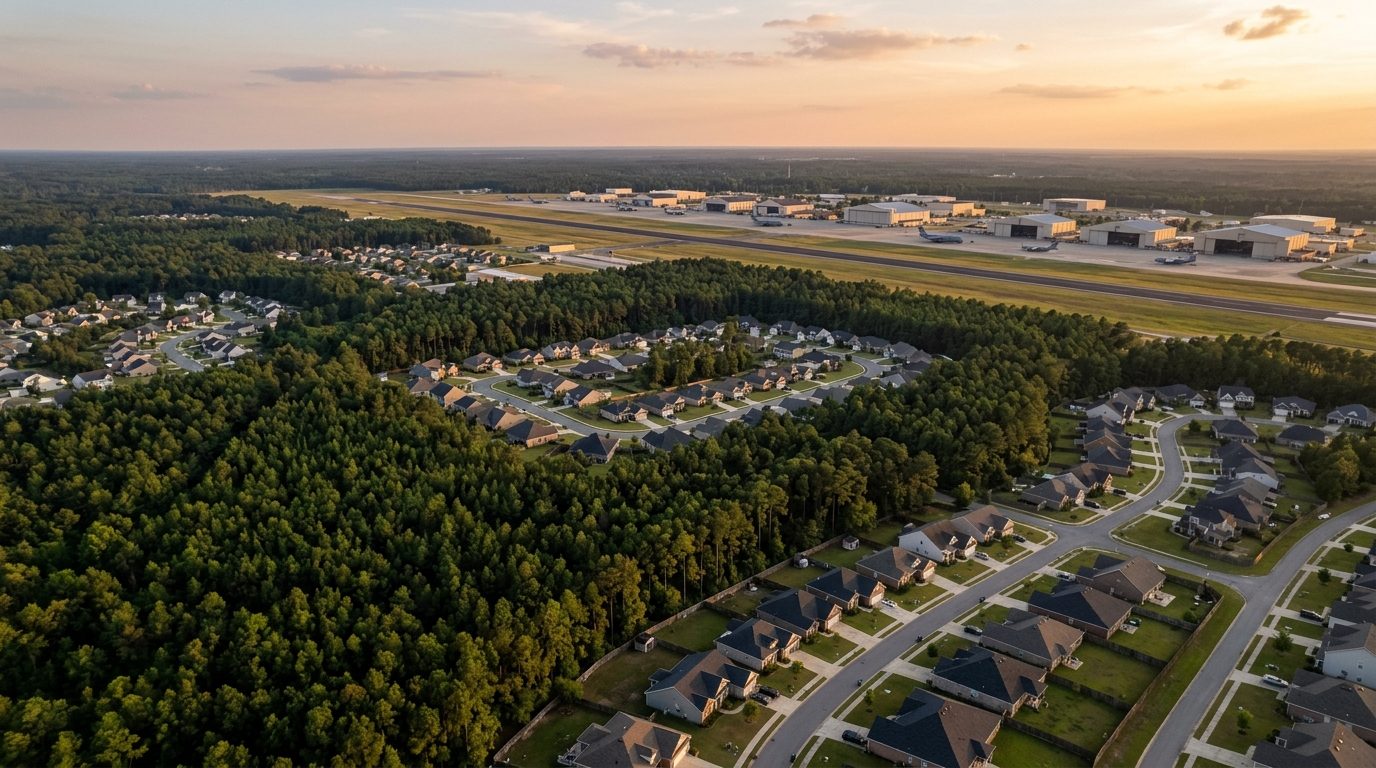
Warner Robins sits in the transition zone between Georgia’s Piedmont plateau and the upper Coastal Plain, in Houston County with Peach County adjoining to the west around Fort Valley. The terrain is flat to gently rolling, covered in mixed pine and hardwood stands and drained by small creeks that feed toward the Ocmulgee River to the east. Interstate 75 runs along the eastern edge of the metro, linking Warner Robins north to Macon, while state routes carry local traffic through Centerville, Perry, and Byron. Housing stock reflects decades of steady, base-driven growth: brick ranch homes and modest post-war subdivisions form the older core near downtown Warner Robins, while newer single-family subdivisions with vinyl and brick-veneer construction spread outward toward Centerville, north Warner Robins, and Perry.
Within the metro, price tiers track distance from Robins Air Force Base’s runway and flight paths as much as any single amenity. Newer subdivisions on the north and west sides of Warner Robins, along with growth areas around Perry near the Georgia National Fairgrounds, tend to sit at the higher end because they combine recent construction with distance from noise contours and industrial base activity. Older neighborhoods closer to the base’s main gates and the original mid-century core of Warner Robins, along with pockets near older commercial strips, tend to be more affordable, reflecting smaller lots, aging housing stock, and closer proximity to base operations. Fort Valley and the rural stretches of Peach County offer a more agricultural, lower-density alternative outside the suburban core.
The metro’s economy is anchored by Robins Air Force Base, home to the Warner Robins Air Logistics Complex, which maintains and repairs Air Force aircraft and employs a large civilian and military workforce alongside a cluster of aerospace and defense contractors that have located nearby to serve the base’s supply chain. Healthcare is another major employment sector, led by the hospital system in Warner Robins and Perry that joined Emory Healthcare in 2025. Retail and services concentrate along the Watson Boulevard corridor, which functions as a shopping hub for Houston County and surrounding rural areas. To the west, Fort Valley and Peach County retain a strong agricultural identity built on peach and pecan orchards, supported by Fort Valley State University, a public land-grant historically Black university that anchors the town’s economy and community life alongside the Georgia National Fairgrounds and Agricenter in nearby Perry.
Because so much of the local economy runs through a single military installation, the metro’s fortunes are closely tied to federal defense budgets, base mission assignments, and periodic Base Realignment and Closure reviews, a dependency buyers should weigh when evaluating long-term stability. Central Georgia’s humid subtropical climate brings hot, humid summers and mild winters, along with a spring severe-weather season that carries a real risk of tornadoes and damaging thunderstorms. Growth along the I-75 corridor has outpaced some infrastructure in Houston County, so buyers should check school district lines, since Houston and Peach counties operate separate systems, confirm flood zone status near local creeks, and ask whether a property falls within an accident potential zone or high-noise contour tied to base flight operations before making an offer.
Cities and Towns in the Warner Robins Metro Area
Notable Communities and Neighborhoods
Warner Robins Real Estate Market FAQ
How is the Warner Robins metro area organized geographically?
The metro centers on Warner Robins and Robins Air Force Base in Houston County, with Centerville immediately northwest of the base and Perry to the south along the Interstate 75 corridor. Peach County, anchored by Fort Valley, sits just to the west and adds a more rural, agricultural character to the metro alongside Byron in northern Houston County.
Which parts of the metro tend to be pricier, and why?
Newer subdivisions on the north and west sides of Warner Robins and growth areas around Perry tend to command higher prices because they pair recent construction with greater distance from the base’s runway and flight paths. Older sections near the base’s main gates and the original downtown core tend to be more affordable, reflecting smaller lots, older housing stock, and closer proximity to base noise and industrial activity.
What should buyers verify locally before purchasing here?
Buyers should confirm whether a property lies within an accident potential zone or noise contour tied to Robins Air Force Base flight operations, check flood zone status near area creeks, and verify which county school district and city or unincorporated jurisdiction the property falls under, since Houston and Peach counties operate separate school systems and tax structures.
What is the biggest region-specific risk for this market?
The metro’s economy is unusually dependent on a single federal installation, so employment and housing demand are sensitive to defense budget cycles, base mission changes, and periodic Base Realignment and Closure reviews. A downturn in base activity or a shift in its assigned workload would ripple broadly through the local economy.
Nearby Markets