
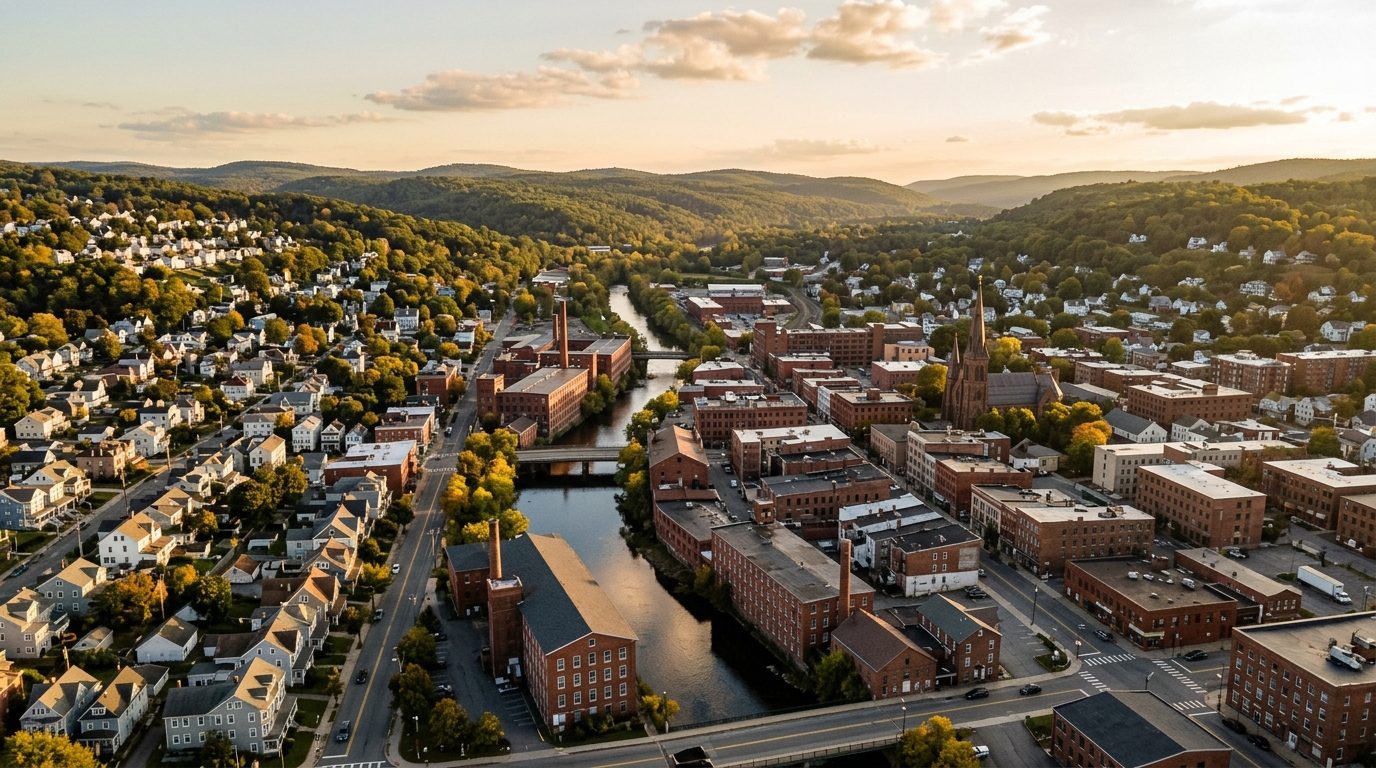
Current real estate market data, news and analysis for the Waterbury-Shelton, CT metropolitan area — 463,349 residents across Naugatuck Valley Planning Region county.
Sources: U.S. Census Bureau.
Latest Waterbury Real Estate News
Coverage of this market is coming soon. Browse all housing market news.
Waterbury Real Estate Market Overview
The Waterbury-Shelton metro occupies the Naugatuck Valley in west-central Connecticut, where the Naugatuck River cuts a narrow industrial corridor between the Litchfield hills to the north and the ridgeline that runs south toward the Housatonic River. Waterbury, long nicknamed the Brass City for its 19th- and early 20th-century brass manufacturing, anchors the region as its urban core, its downtown and surrounding neighborhoods dense with triple-deckers, brick rowhouses, and worker cottages built during the industrial boom, alongside mill and factory buildings that have since been converted or left for redevelopment. Outside the city, the landscape turns hillier and more wooded, and towns such as Watertown, Wolcott, Plymouth, Thomaston, Prospect, Middlebury, Oxford, Southbury, Woodbury, Bethlehem, Beacon Falls, and Seymour are predominantly suburban and semi-rural, built up mostly after the Second World War with colonials, capes, and ranches on larger lots, plus newer subdivision construction toward the valley’s outer edges.
Pricing across the metro tends to track distance from the urban core and the age of the housing stock. Southbury, Woodbury, and Cheshire generally sit toward the higher end of the range, owing to newer construction, larger parcels, well-regarded school systems, and highway access without the density of a former mill city. Waterbury’s own neighborhoods, by contrast, skew lower, reflecting older multi-family buildings, smaller lots, and the lingering effects of postindustrial disinvestment in parts of the urban core. Towns like Watertown, Wolcott, Plymouth, Thomaston, Prospect, and Seymour fall in between, mixing older village centers with postwar suburban tracts at a middle price point.
Healthcare and manufacturing anchor the local economy. Yale New Haven Health now owns and operates Waterbury Hospital, while Saint Mary’s Hospital, part of Trinity Health of New England, is another major employer in the city. MacDermid, a specialty chemicals manufacturer serving the electronics and industrial-finishing markets, is headquartered in Waterbury, a direct descendant of the region’s brass and metalworking legacy, and Timex Group’s U.S. operations were long headquartered in nearby Middlebury. Post University and Naugatuck Valley Community College add to the local employment and education base. Beyond the metro’s own job base, many residents commute outward, toward Hartford via Route 8 and I-84, toward New Haven, and toward New York City on Metro-North’s Waterbury branch line, which connects through Bridgeport to the New Haven Line.
Buyers should weigh a few region-specific factors. Winters bring routine New England cold and snow, but the metro is entirely inland, carrying none of the coastal flood or storm-surge exposure found along Connecticut’s shoreline. Connecticut’s property tax structure is notably significant relative to home value and varies by town, so it is worth checking mill rates and any revaluation schedule directly with each town’s assessor rather than assuming a rate carries over from a neighboring community. The age of the housing stock, particularly in Waterbury’s older neighborhoods and the historic village centers of surrounding towns, makes inspection for outdated wiring, aging roofs, and lead paint especially important, and homes near former industrial sites along the river corridor warrant a look at environmental history. In the more rural towns, including Bethlehem, Woodbury, and parts of Oxford, private wells and septic systems are common and worth independent testing. Local zoning also varies widely across the region’s many small towns, so confirming permitted uses with the relevant town is a reasonable step before purchasing.
Cities and Towns in the Waterbury Metro Area
Notable Communities and Neighborhoods
Waterbury Real Estate Market FAQ
How is the Waterbury-Shelton, CT market organized?
There is no county government in Connecticut, so the metro is best understood as a group of towns within the Naugatuck Valley planning region rather than a single county market. Waterbury forms the urban core, while towns including Watertown, Wolcott, Plymouth, Thomaston, Prospect, Middlebury, Oxford, Southbury, Woodbury, Bethlehem, Beacon Falls, and Seymour make up the surrounding suburban and rural ring, each with its own town government, schools, and zoning rules.
Which parts of the metro tend to be pricier, and why?
Southbury, Woodbury, and Cheshire generally command higher prices, largely because of newer housing stock, larger lots, and well-regarded school districts, combined with easier highway access and a more rural, low-density character. Waterbury’s urban neighborhoods tend to be more affordable, reflecting older multi-family housing and smaller lots typical of a former mill city, with the surrounding towns falling in between.
What should buyers verify locally before purchasing in this region?
Buyers should confirm the property’s mill rate and tax history directly with the town assessor, since rates vary town by town and are not uniform across the region. In the more rural towns it’s also worth verifying whether the home relies on a private well and septic system, and having both tested independently. Checking zoning classifications and any pending development or redevelopment plans with the town or the Naugatuck Valley Council of Governments is another useful step.
What is a notable risk factor specific to this metro?
Connecticut’s property tax burden relative to home value is a structural factor buyers should plan for, since it can vary meaningfully from one town to the next even within the same metro. Older housing stock, particularly in Waterbury’s historic neighborhoods and the village centers of surrounding towns, also warrants a thorough inspection for outdated electrical systems, aging roofs, and lead-based paint given the age of construction common throughout the region.
Nearby Markets