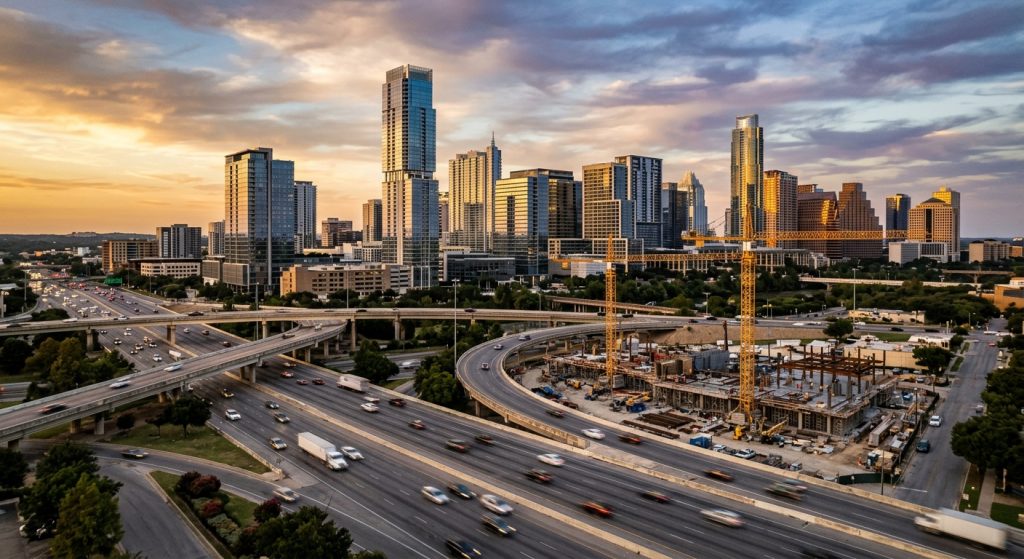
Dallas-Fort Worth is the top U.S. market to watch for the third straight year, and San Francisco has vaulted 40 places into the top five, according to Emerging Trends in Real Estate 2027, the annual outlook PwC and the Urban Land Institute released Oct. 27. The 48th edition of the report also finds an industry whose property-type preferences have narrowed sharply, with data centers suffering the survey’s steepest one-year drop and infrastructure assets rated above every traditional commercial category.
The report draws on what PwC described as insights from nearly 1,500 real estate investors, developers, lenders and advisers across the U.S. and Canada. According to the report’s notice to readers, researchers interviewed more than 500 people and received survey responses from almost 1,000.
The 2027 markets to watch
The five highest-ranked U.S. markets for overall real estate prospects are:
- Dallas-Fort Worth
- Nashville
- Miami
- Raleigh-Durham
- San Francisco
The report also profiles five markets “whose individual stories merit close attention”: Manhattan, Phoenix, Orange County, Columbus and Seattle.
The rankings are a composite of investment, development and homebuilding prospect scores that survey respondents rate on a one-to-five scale. The authors caution that scores among the top markets are closely clustered, so small changes in responses can shift positions, and they say the list should be read as “directional indicators of industry sentiment rather than precise ordinals.”
Within those limits, the year’s movement was striking. San Francisco rose from 45th in the 2026 edition to fifth, which the report’s markets chapter attributes to AI-sector leasing and the technology industry’s expansion, which it says have cut the city’s office vacancy by more than 500 basis points from its peak. Knoxville, Tenn., climbed 46 spots to 20th on defense-technology activity and affordability. Nashville moved from sixth to second, a rise the report ties to a maturing health care sector, a technology campus and stadium investment.
Dallas-Fort Worth held the top spot on what the report calls the market’s scale, diversification and infrastructure ambitions, citing its role as a major data center market, the launch of the Texas Stock Exchange and a multibillion-dollar projected manufacturing pipeline. Southern and Southeastern markets account for six of the top 10.
Elsewhere, Manhattan rose from ninth to seventh, continuing a climb from 42nd in 2022, and the New York corridor placed three markets in the top 15, with Jersey City eighth and Northern New Jersey 15th. Seattle fell from 22nd to 38th even though, the report notes, it posted its best new office leasing since 2019 in the first nine months of 2026. Austin, Texas, which slid from 15th in 2025 to 30th in 2026, recovered only to 21st. Columbus, Ohio, ranked 19th, which the authors link to a semiconductor campus of roughly $28 billion; the report also says the city ranks third nationally as a data center market.
The report also flags a split between where investors want to be and where builders can work. Markets that rank highly overall do not necessarily rank highly for homebuilding, it says, because the entitlement barriers that make existing assets valuable slow new construction. It points to Chicago, Philadelphia and Detroit as places where relative affordability and pent-up household formation are generating housing demand that “industry sentiment has not yet fully recognized.”
Data centers slip, infrastructure leads
The property-type outlook describes a compressed hierarchy: the gap between the highest- and lowest-rated major property types for investment prospects is roughly half what it was three years ago.
Data centers, which had held the top investment and development prospect ranking for three consecutive years, posted the survey’s most significant single-year decline. The authors say the drop reflects “not diminished demand but growing awareness of execution constraints, power limitations, and regulatory friction.” Four infrastructure categories were included in the survey for the first time (energy and renewables, transportation, digital infrastructure beyond data centers, and water and utility systems), and each drew higher investment ratings than any established property type.
Among established sectors, industrial and distribution posted the strongest investment prospect score. Retail ratings improved for a fifth consecutive year. Office improved for a fourth straight year, and central city office recorded the largest gain of any subsector, which the report attributes to actual leasing, particularly from technology and AI tenants, while noting that high vacancy, elevated delinquencies and heavy capital needs still weigh on the sector.
Housing went the other way. Multifamily and single-family ratings both declined, and single-family development prospects showed the sharpest year-over-year drop among major property types. One senior researcher quoted anonymously in the report described multifamily as a market working through “what the bottom looks like” after record 2023 and 2024 deliveries. Senior housing and medical office shared the top position among established subsectors for investment prospects. That is consistent with the occupancy gains senior housing landlords have been reporting, including in Welltower’s third-quarter results, which came with a raised 2026 outlook.
“You Have to Work for It”
The report’s theme for 2027 is “You Have to Work for It,” following last year’s “Navigating the Fog.” Andrew Alperstein, national real estate leader in PwC’s Financial Markets & Real Estate practice, said sentiment in the publication declined this year even as the industry looks for ways to grow.
“Capital is available, debt markets are functioning and repricing could create attractive entry points, but higher borrowing costs and greater variation across sectors and submarkets are raising the bar for execution,” Alperstein said in the release. “In 2027, success will be less about making a broad sector bet and more about choosing the right asset, in the right market, with the right operating strategy.”
Angela Cain, global CEO of ULI, said the report pairs broad industry insight with market-level intelligence and can help leaders navigate “a market that will reward discipline, adaptability and deep local knowledge.”
The eight trends the report identifies are a “fiscal reckoning,” in which deficits and elevated Treasury yields make higher-for-longer rates the new reality and loan maturities force transactions; an expanding real estate universe that now includes energy, utilities, cold storage and even veterinary clinics; “policy is the new geography,” covering rent control, insurance, permitting and utility limits; demographics; a “great submarket sort,” in which performance diverges more within metros than between them; a coming supply gap as development pipelines shrink; AI and the “human premium”; and district-scale “reimagining places” built around stadiums, universities and semiconductor plants.
Two survey figures show how much location decisions now depend on things outside a building’s walls. In the markets chapter, 45.3% of respondents named energy and power grid constraints as a top disruptor, and 72.4% said insurance costs were moderately or significantly affecting real estate decisions in their markets.
The tone is more cautious than Deloitte’s 2027 commercial real estate outlook, which also showed weaker sentiment but revenue expectations near a record. On our reading, the two reports agree on the main point: capital has returned, but it is choosing narrowly by market, by sector and by asset.
For investors, the practical message of the rankings is less about the top five than the spread beneath them: markets such as San Francisco and Knoxville moved dozens of places in a year on specific demand drivers, while others slipped despite real leasing gains. Follow the sector in our commercial real estate coverage.