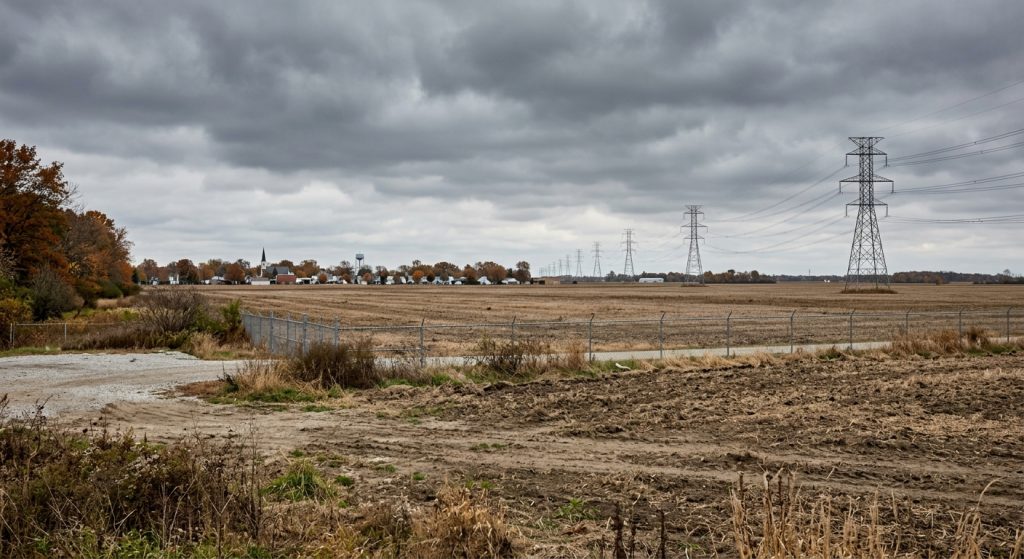
Lordstown, Ohio, does not have to keep reviewing a data center developer’s site plan while the village’s moratorium on data centers is in effect, even though the developer submitted the plan before the freeze began. The Supreme Court of Ohio ruled on Oct. 20, 2026. The decision gives Ohio towns a clear answer on a question many have faced as data center proposals have spread: whether early paperwork locks in the rules that applied on the day it was filed.
All seven justices joined the unsigned per curiam opinion in State ex rel. Bristolville 25 Developer, L.L.C. v. Lordstown, Slip Opinion No. 2026-Ohio-4073. The court denied the developer’s request for a writ of mandamus, a court order that forces a public official to perform a duty the law requires. Bristolville 25 Developer and the landowner, BHGH Properties, had asked the court to make the village and its planning-and-zoning administrator, Kellie D. Bordner, review the project under the zoning rules in place before the moratorium.
Lordstown data center plan stalled at step one
According to the full opinion, Bristolville describes itself as a company that acquires and develops land for large-scale data centers across the United States. In February 2025 it agreed to buy an industrially zoned parcel in Lordstown, a Trumbull County village. The court’s public information office said the plan called for four three-story data centers and ancillary structures.
Lordstown requires a site-plan review before anyone can apply for a zoning permit for new construction. The village’s two-page “Overview” of that process sets out four steps: draft materials, a pre-application meeting, written comments from the village engineer and others, and a final submission to the Planning Commission. Only after the commission approves a site plan can a developer apply for a zoning permit.
Bristolville hand-delivered its draft narrative and site plan on Oct. 20, 2025. The next day Bordner emailed that the office could not proceed until the village council voted on a pending ban on data centers. The council passed that ban, Ordinance No. 57-2025, as an emergency measure on Nov. 3, 2025. The village then repealed it before it took effect. In its place the council unanimously adopted Ordinance No. 1-2026, a moratorium of up to 180 days on issuing new permits for data centers and on receiving and processing permit applications for them. The opinion says the review process halted on Jan. 5, 2026, when the moratorium was enacted. The council also voted not to approve the village engineer’s work authorization, which is required before review can continue. On June 15, 2026, the council extended the moratorium for another 180 days.
Why the court said no vested right existed
Bristolville’s main argument relied on two older Ohio Supreme Court decisions. In Gibson v. Oberlin (1960), the court held that a property owner who meets every legislative requirement for a building permit has a right to it, and that this right vests when the permit application is filed. In State ex rel. Fairmount Ctr. Co. v. Arnold (1941), the court struck down a “stop-gap” ordinance a city had used to block a permit while it rezoned the owner’s property.
The justices said Bristolville misapplied both cases. In each, the owner had already satisfied the requirements for a permit. Bristolville, by contrast, “has not yet applied for a permit to begin construction, much less met all legislative requirements for obtaining such a permit,” the opinion states. “Bristolville is essentially asking to apply a vested-rights rule to the site-plan review process.”
The court concluded that “under the moratorium, the village is under no legal duty to proceed with a site-plan review of Bristolville’s project” and that the developer had not shown a clear legal right to review under the pre-moratorium ordinance.
Bristolville also made a policy argument. If rights do not vest until a site plan is approved, it said, applicants would have no protection against rule changes during the application process, and localities would be encouraged to use delaying tactics. The court did not engage with the merits of that argument. “The remedy for relators’ policy concern, however, is not a writ of mandamus,” it wrote, adding that creating such a duty “is a legislative and not a judicial function.”
The village did not win on every point. The court rejected its arguments that the case was really a disguised declaratory-judgment action outside the court’s jurisdiction, that the repeal of the original ban made the case moot, and that the village was already performing the review. The court also did not reach the village’s argument that Bristolville had an adequate remedy through an administrative appeal.
A pattern of data center fights reaching Ohio’s top court
The Lordstown case follows two other data center disputes the Supreme Court has decided since August. On Aug. 7, 2026, the court ordered Ashville’s fiscal officer to send a referendum petition on the village’s tentative agreement with EdgeConneX, covering two data centers and a natural-gas power plant, to the board of elections. On Sept. 18, it kept a citizen initiative regulating data centers in Wilmington off the Nov. 3 ballot because the measure would have created a private right to sue, which the court said a city cannot enact.
The Lordstown ruling is narrower than a ruling on whether data center moratoriums are valid. The court did not decide that; it assumed a “duly enacted moratorium” was in effect. What it settles is timing. On our reading, a developer in Ohio that has only begun a preliminary review step has not locked in the old rules, so a town can pause the process while it rewrites its code. Lordstown is doing that. The court took judicial notice of Ordinance No. 16-2026, which hires consultant Brian Frantz to help amend the village’s planning and zoning code. According to the developers, that work will include a conditional-use permit process and regulations specific to data centers.
Local pushback has become a central risk for data center developers nationally. RealtyWire has covered how local opposition stalled $68 billion of data center projects in the second quarter and how Indianapolis finalized a data center moratorium through 2027. Under the extension, Lordstown’s moratorium runs through the end of 2026. For more on development and land use, see our Commercial Real Estate coverage.