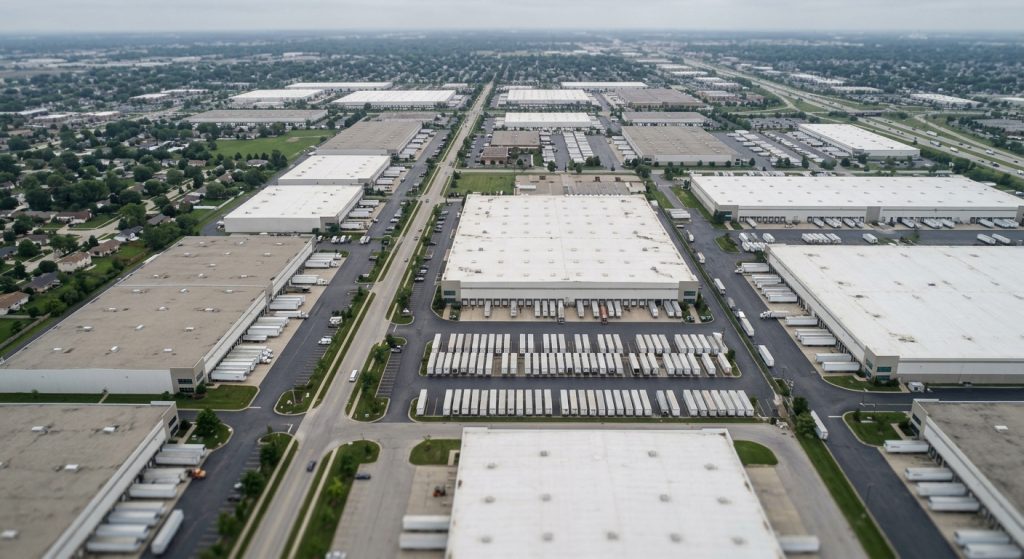
Vacancy in Chicago’s industrial real estate market rose to 5.06% in the second quarter of 2026, up 15 basis points from the prior quarter, according to Colliers’ latest Chicago Industrial Market Report. The uptick in the nation’s largest industrial market is a signal worth watching for anyone tracking logistics and warehouse demand nationally, since Chicago’s rail and highway hub status has long made it a bellwether for e-commerce and freight activity.
Colliers researchers Diana Perez and Grant Levin attributed the increase primarily to “second-generation space returning to the market” — meaning previously occupied warehouses being vacated rather than a slowdown in new construction demand.
Context: from boom to balance
Chicago’s industrial sector spent much of the early 2020s in a historic boom. Vacancy bottomed out near 4.5% in late 2022 as e-commerce operators, third-party logistics firms and manufacturers raced to secure warehouse space near the metro’s rail yards and interstate corridors. Many of those tenants signed five-year leases at the height of pandemic-era demand.
Those leases are now starting to expire, and Colliers’ data shows the market gradually normalizing after several years of extremely tight conditions rather than a sudden collapse in demand.
The shift also comes as national industrial vacancy is expected to trend higher through the rest of 2026, according to separate Colliers research covering the broader U.S. market. Chicago, however, remains well below many coastal and Sun Belt metros that saw heavier speculative overbuilding during the pandemic boom, giving the market more cushion than some regions now working through larger supply gluts.
The numbers
According to Colliers:
- Vacancy reached 5.06% in Q2 2026, up from 4.67% in the second quarter of 2025 — roughly a 39-basis-point increase year over year.
- Net absorption totaled 1.4 million square feet in the second quarter, a 63% decline from the first quarter.
- The construction pipeline grew 8.5% to 13.5 million square feet under development.
- Average asking net rents rose 6.3% year over year, though Colliers noted the pace of rent growth is slowing.
Submarket activity remained concentrated in the Joliet corridor, a key logistics gateway southwest of the city. Hyundai Translead leased 2.3 million square feet across two buildings, and KeHe Distributors took 1.2 million square feet at the Cherry Hill Business Park, according to industry reporting.
Speculative development is also creeping back. Industry reports indicate a vertical warehouse project near Goose Island is nearing a deal with Amazon, and Prologis is preparing to break ground on two speculative warehouses in Glendale Heights — early signs that developers see room for new supply despite the softer absorption numbers.
What it means
The rise in vacancy does not yet indicate a downturn. Colliers’ own figures show leasing activity and net absorption both remained positive in the second quarter, just at a slower pace than earlier in the cycle. Colliers vice chair Mike Senner has indicated that some tenants are consolidating from multiple smaller buildings into fewer, larger facilities as leases roll over — a structural shift in how space is used rather than a pullback in overall demand.
RealtyWire’s analysis: with the construction pipeline expanding faster than absorption is growing, landlords in some Chicago submarkets may face more competition for tenants over the next several quarters, particularly for older “second-generation” buildings that no longer match tenants’ operational needs. Readers can track broader shifts in industrial and commercial real estate as more Q2 metro reports are released nationally.
What to watch
Colliers’ next quarterly report, due in October, will show whether the third-quarter rise in vacancy documented over the past three quarters continues or levels off. Also worth tracking: whether the Goose Island warehouse project finalizes its reported Amazon deal, how quickly Prologis leases its planned Glendale Heights buildings, and whether net absorption rebounds after its second-quarter slowdown. Continued national industrial market coverage will show whether Chicago’s modest softening is part of a broader logistics-sector trend or a local adjustment after an unusually tight multiyear run.
Related coverage: Opus Starts Construction on 898,500-Square-Foot Spec Industrial Park in Canal Winchester · Manhattan Apartment Rents Hit All-Time High in June 2026 · Mortgage Rates Climb to Highest Level of 2026, Freddie Mac Says