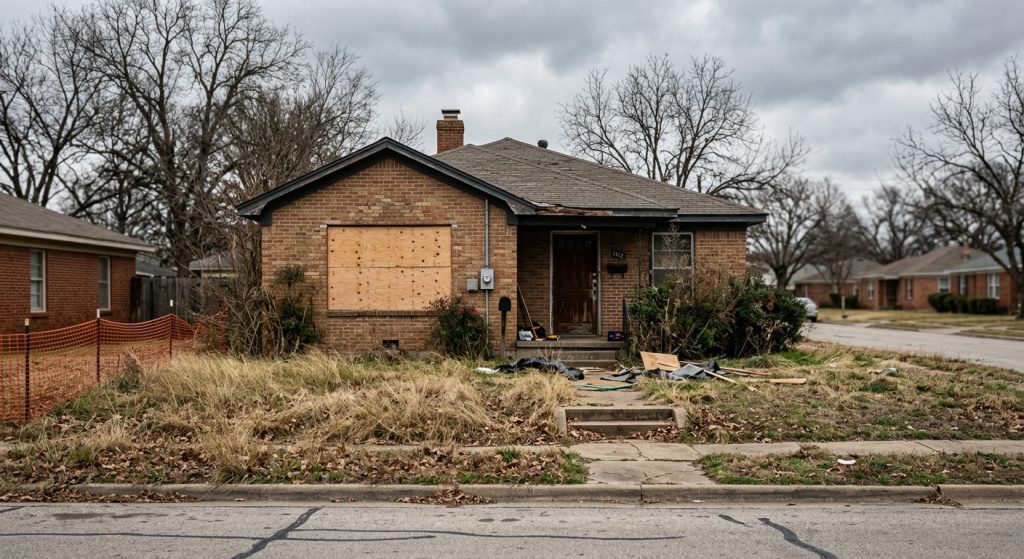
The president of a Dallas, Texas, real estate investment firm who raised money under the “We Buy Ugly Houses” banner was sentenced to 188 months in federal prison — more than 15 years — for a wire fraud scheme that took in money from more than 80 investors.
Charles Carrier, 67, was sentenced by U.S. District Judge Brantley Starr and ordered to pay $24,416,911.16 in restitution, the U.S. Attorney’s Office for the Northern District of Texas announced on Sept. 23. Carrier pleaded guilty to wire fraud on Oct. 30, 2025. Prosecutors said he intended to defraud investors out of $39,514,300.
Liens that were never recorded
The mechanics matter to anyone who has ever lent against a house. According to court documents cited by prosecutors, Carrier raised money from 2018 through 2024 by telling investors their funds would buy, renovate and resell specific residential properties, and that their loans were secured by first-position liens.
They frequently were not. Prosecutors said Carrier repeatedly failed to record the promised deeds of trust, issued multiple deeds of trust against the same property, and concealed the overlapping encumbrances from the people who had funded the deals. He also sold properties without telling the investors behind them, using forged or unauthorized lien releases to clear title so the sales could close.
The money went to personal expenses, unrelated business costs and payments to earlier investors, prosecutors said — the pattern that turns a failing business into a fraud case. Restitution was set at roughly $24.4 million, below the nearly $39.5 million prosecutors said Carrier intended to take; intended loss and ordered restitution are separate calculations in federal fraud sentencing.
A trusted brand as the entry point
U.S. Attorney Ryan Raybould made the brand central to how he described the case. “Financial fraud isn’t just numbers on a ledger—it’s a direct assault on hardworking Americans who trusted an alleged expert with their savings,” Raybould said. “Carrier didn’t just target investors; he preyed on Main Street families, retirees and small business owners through a sham ‘We Buy Ugly Houses’ scam. Through his lies and deceit, Carrier earned every month of his 15-year sentence. This case should serve as a warning to those who target Main Street Americans in North Texas.”
“We Buy Ugly Houses” is the consumer-facing slogan of HomeVestors of America, the Dallas-based franchisor that licenses the slogan to independent franchisees. ProPublica, which has reported on the case since before Carrier’s guilty plea, identified his firm as C&C Residential Properties and described it as one of the chain’s most productive franchises. The Justice Department’s announcement names neither the firm nor the franchisor, and HomeVestors is not accused of wrongdoing in the case.
The FBI’s Dallas Field Office investigated. Its special agent in charge said the sentence “underscores the harm investment fraud inflicts on victims and communities,” adding that the bureau urges the public “to carefully research any investment opportunity and to contact us immediately if they encounter suspicious activity.” Assistant U.S. Attorney Douglas B. Brasher of the Fraud Section prosecuted.
Why private lending keeps producing these cases
Carrier’s investors were doing something ordinary: lending private money against single-family houses, secured — they believed — by a recorded deed of trust. That structure is the backbone of the fix-and-flip economy, and its safety depends entirely on a filing at the county clerk’s office that most individual lenders never independently verify.
The sentence arrives in a market where small residential investors are already retreating. RealtyWire reported this summer that real estate investor sentiment fell to a record low in an RCN Capital survey, and that the investor share of home purchases slipped to 27% in the second quarter as the largest buyers pulled back. Higher borrowing costs and thinner resale margins have squeezed exactly the kind of renovate-and-resell business Carrier told investors he was running.
Fraud against real estate investors and buyers has been trending the other way. A title-industry study this month found that seller impersonation fraud attempts more than doubled in two years, and federal regulators have brought their own cases against real estate investment vehicles, including an SEC action in August alleging $152 million in fraud at RAD Diversified REIT.
Carrier’s case is narrower than those — one wire fraud count, one defendant, one city — but it is the kind that reaches ordinary lenders directly. On our reading, the checks that would have exposed it are the unglamorous ones: whether the deed of trust was actually recorded, whether it sits in first position, and what else has been filed against the same property since.